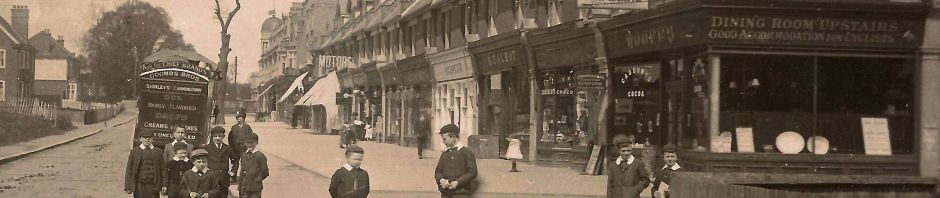
In 1856 T L Wilson wrote that in the eighteenth-century Hall Lane was a “fine avenue of oaks and elms, closed by a gate” with osier beds on the right hand (east) side. A series of developments transformed this rural aspect, the first changes being on land at the southern end, gifted or leased by the Branfill family. Further major changes arose later with the development of the Upminster Garden Suburb after 1906, with more changes after the Branfill trustees sold their remaining properties in 1921.
The first incursion came in 1848 when Mrs Branfill of Upminster Hall presented a site formerly “encircled by pollards” to allow a National School and adjoining school master’s house to be built. Wilson described these buildings, which were opened on 25 March 1851 at a cost of £580 raised by subscription and government grant, as being “in the Tudor style, built of red brick, with white dressings to the windows, &c., the copings and ornamental parts being of Caen stone”. Wilson went on to write that at “the north-west angle, upon an open bell tower, a slated spire rises to the height of about fifty feet.” Although built for 100 children, Wilson considered the schoolroom to be “somewhat restricted and inconvenient in shape” and which could “scarcely accommodate conveniently more than 80 children”.
The first school master of the National School was Thomas Eastgate, a 41-year-old born in Ashford, Middlesex, who lived in the adjacent schoolhouse with his school-mistress wife Helen. Eastwood left in 1854 and there were two more headmasters before Buckinghamshire-born George Frederick West took on the role in 1877. West was the Headteacher for 41 years until his retirement in 1918, making Upminster his home, marrying Annie Day, a daughter of Henry Day, the publican of the Bell. He was initially supported by his younger sister Alice, until her marriage to Upminster-born William Frederic Rowe, after which his wife Annie seems to have assisted him.
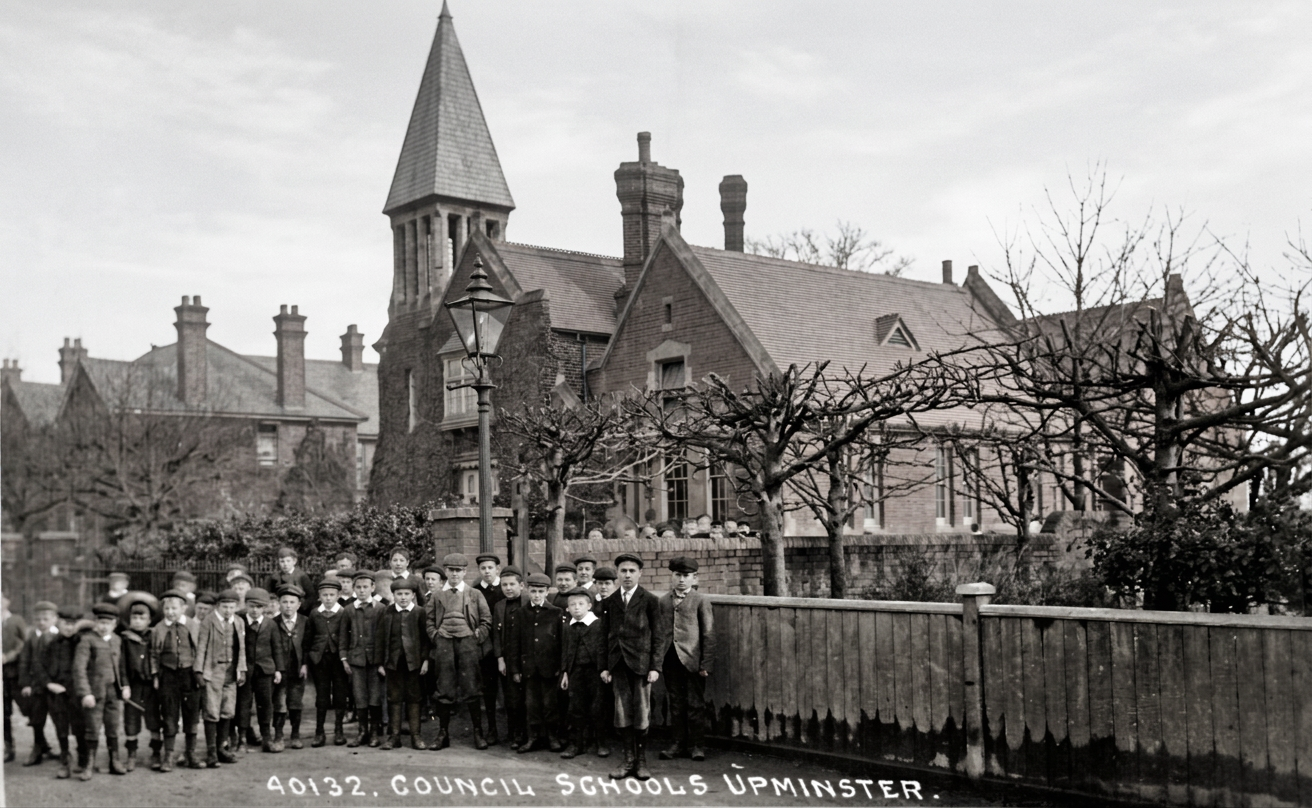
George West was involved in parish affairs, becoming the clerk to Upminster’s first parish council when it was formed in 1894. He was elected to the parish council as a member in 1897, serving until 1928, including spells as Chairman from 1910 to 1914 and again in 1925-26. George and Annie West were childless, but long after his death in 1932 aged 78 the former school master was affectionately remembered through the memories of the numerous pupils who had attended the school during his long-serving headship.
In 1884 the National School merged with the British School opposite, under the control of a newly elected School Board. The British School became the Girls and Infants School while the National School premises housed the Boys’ School under George West’s headship. In 1897 the former National School building was extended, increasing the capacity to 126, although average attendance was still only 74 in 1899.
The former school building continued in use until the new Upminster Council School opened next to the Bell Inn in 1927. The growth in Upminster’s population, mainly from the Gaynes Park Estate, required the old school building to be reopened in 1934 until the older children transferred to the new Gaynes Secondary School in September 1936. The vacant former headteacher’s house was occupied from around 1934 by William Vinton, the school caretaker, and his wife Eva, who was the school cleaner.
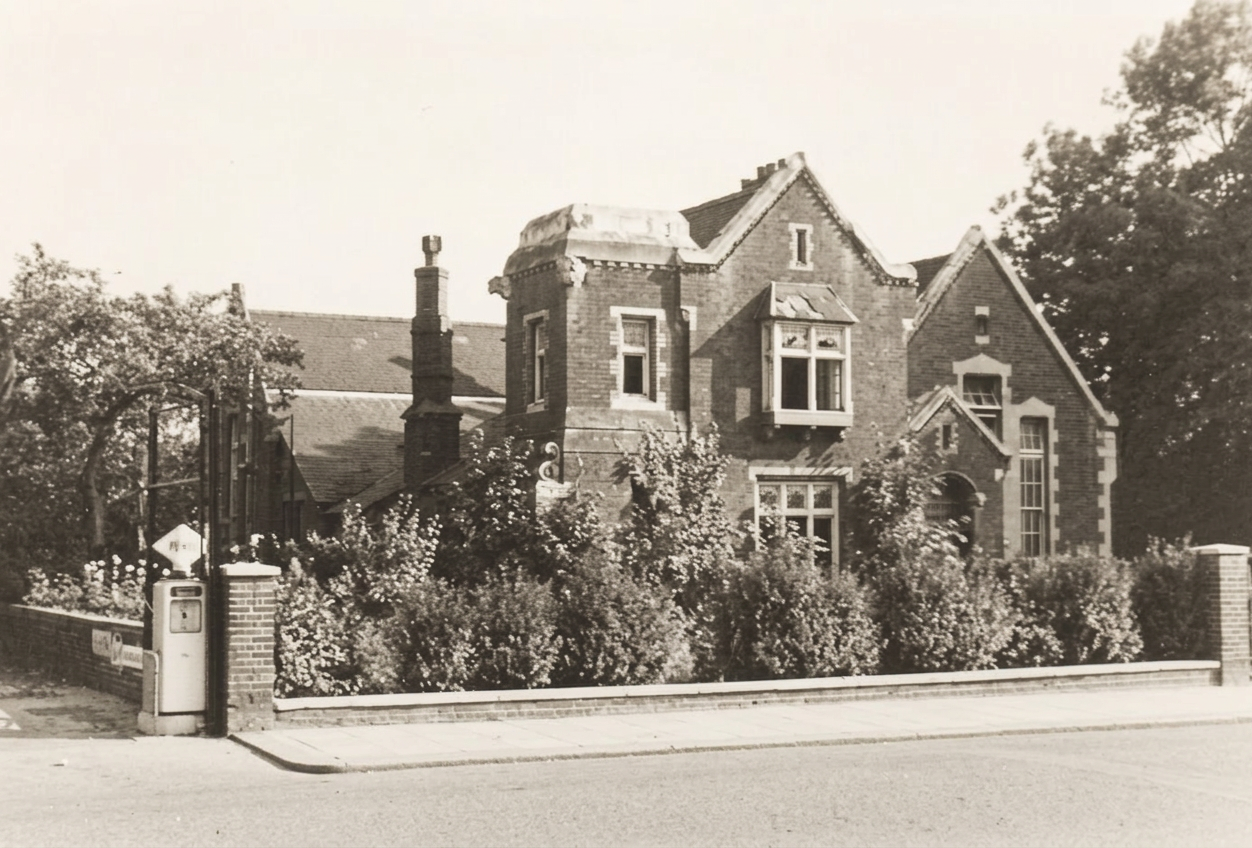
The school buildings were again pressed into service as overflow classrooms for a few years to help accommodate the post war baby boom generation. They were also used as a meeting venues for local associations and as a social club for young people. After standing empty and surplus to requirements, the buildings were demolished in October 1964 to make way for the Westminster Bank (later the National Westminster Bank) and adjacent shops which opened in 1966. After the NatWest Bank closed in 2018 the premises were converted into a BrewDog bar which opened in November 2022.
The next development on the east side after the National School was built came in September 1867 when Thomas Lewis Wilson took out an 80-year lease from Mrs. Branfill on the site south of the National School. Here Wilson developed his new four-bedroomed house which he named America Cottage (later known as America Lodge), relocating his carpenters’ yard from behind what was later known as Aggiss’ or Chestnuts Corner. America Lodge remained Wilson’s home and business premises until his retirement in 1903 when he moved to Grove Cottage in Cranham Lane.
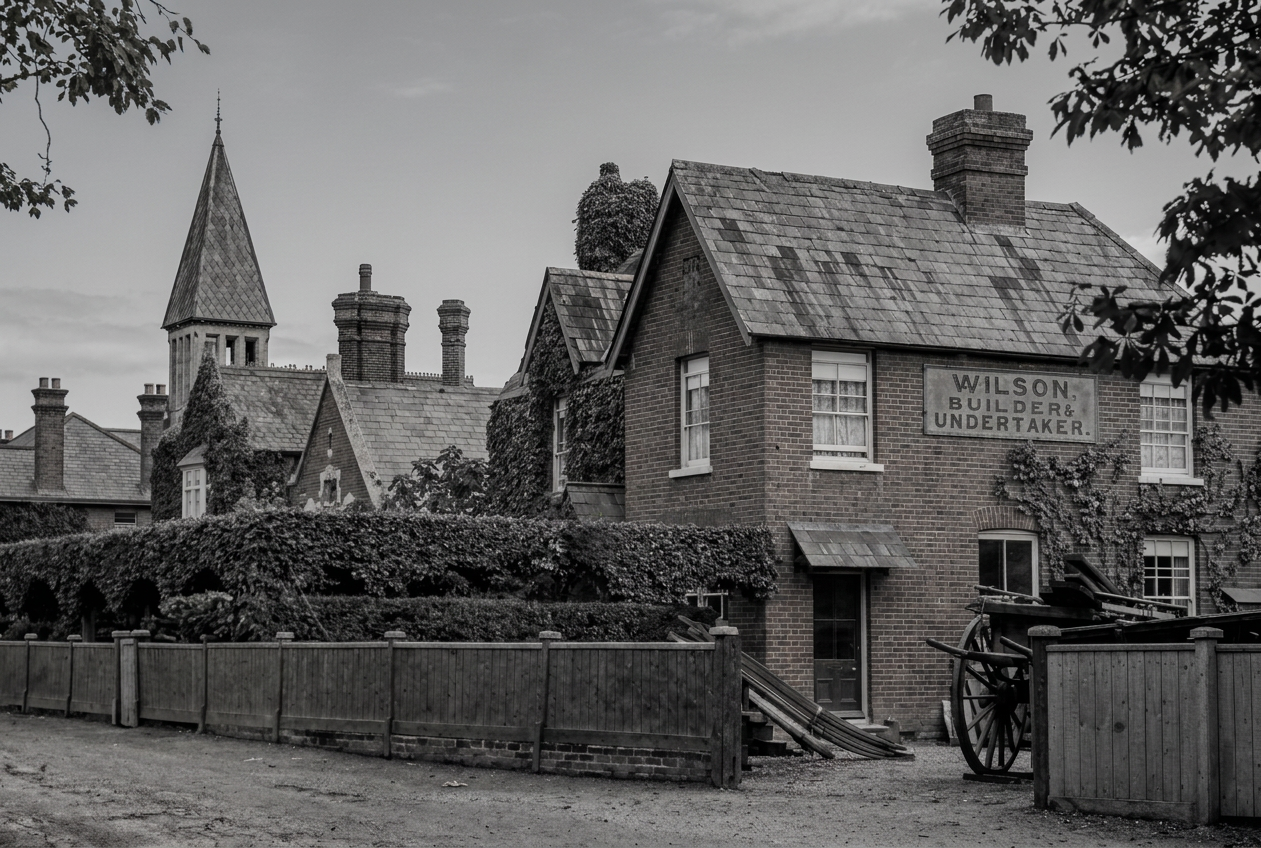
Albert Edward Parrish (1868-1928), succeeded Wilson as the leaseholder of America Lodge at an annual rental of £40, running his business as a cartage contractor from there. When America Lodge was sold by the Branfills in early 1921 it was bought by Harry Frizzell, the baker, and after Parrish moved out, the building was converted to form the Broadway Restaurant; Parrish continued to use the yard for his cartage business until his death in 1928. America Lodge then seems to have been occupied by Frizzell’s daughter Lilian and her husband Alec Bridge, who may have run the Broadway Restaurant. Part of the America Lodge in the late 1920s and early 1930s housed a milliners and ladies clothing store called Madame Elizabeth’s.
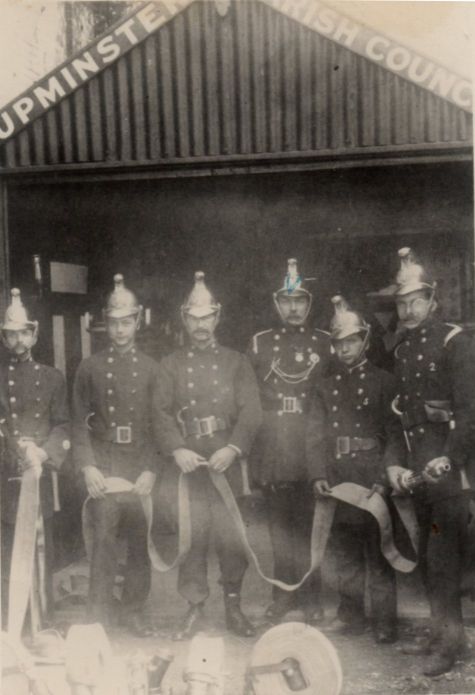
After the volunteer fire brigade was formed in 1909 a wooden shed was built to the south of America Lodge to house the parish fire cart. Once the Upminster Parish Council took over the Clockhouse in 1925 the fire cart was relocated there and the shed afterwards housed The Bureau which seems to have initially offered a typewriting service run by two neighbours from Branfill Road, Miss Ena Youngs, who was later a school secretary, and a Miss Nunn, either Edith (b. 1888) or her younger sister Muriel (b.1892).
Image left: Upminster Volunteer Fire Brigade outside the fire cart shed
After the short-lived Broadway Restaurant closed, America Lodge (and the Wooden Shed, The Bureau) seem to have been unoccupied in the late 1930s before their demolition around 1939, and were afterwards replaced by a new parade of five shops and a new building for Lloyds Bank built behind Cosy Corner, which were started but remained unfinished during the war. Margaret Crabtree recalled that troops housed “Bren gun carriers and food stockpiles …in the unfinished shops”.
The opening of the Barking to Pitsea railway in May 1885 had cut off the southern part of the Branfill’s Upminster Hall estate from the main part north of the new line, with the station, sidings and goods yard built on the southern side.
This seems to have led to the Branfills considering developing the isolated southern part of their estate and in January 1886 a detailed plan for developing that area was prepared for the head of the family, Benjamin Aylett Branfill, by the family’s architects Frederick Chancellor & Company of Chelmsford. The plan included a “Railway Road” running roughly parallel to the London, Tilbury & Southend railway – similar to the route adopted for Howard Road 20 years later – and a “Champion Road”, following a similar line to the later St Lawrence Road. Another planned road ran south from Railway Road, to join St Mary’s Lane opposite the Clockhouse/New Place – matching the later route of Garbutt Road. Branfill tried variations on this plan on several occasions over the coming years but either lacked the finances or failed to attract a developer interested in these plans.
The first actual development after the coming of the railway came in June 1886 when T L Wilson’s former business partner William Hook and the dairyman Edwin Battson were granted 99-year leases on plots 200 feet by 70 feet, to the north of the National School building, on which they built two pairs of semi-detached properties (later numbered 22 and 24, and 26 and 28 Station Road). These premises were sold by the Branfill family Trustees at auction in January 1921.
The pair to the north (numbers 26 and 28) were leased by Edwin Battson (1851-1927) and from the outset Number 28 was Battson’s home and dairy business. To the rear was a diary and cart shed with standing for 20 cows, who were brought in from their pasture for milking, and stables for the horses. After Battson’s retirement around the end of the 1914-18 war, the diary continued as Battson Brothers, operated by his sons Arthur and Frank and then as A.G. Battson & Son, before the business was acquired in the early 1930s by the United Diaries Ltd chain who continued there for many decades. The premises remains a grocer’s shop, now the Co-Operative Store and Post Office, and formerly Morton & Reeves, and later Costcutter.
Image right: Numbers 26 & 28 Station Road c.1912
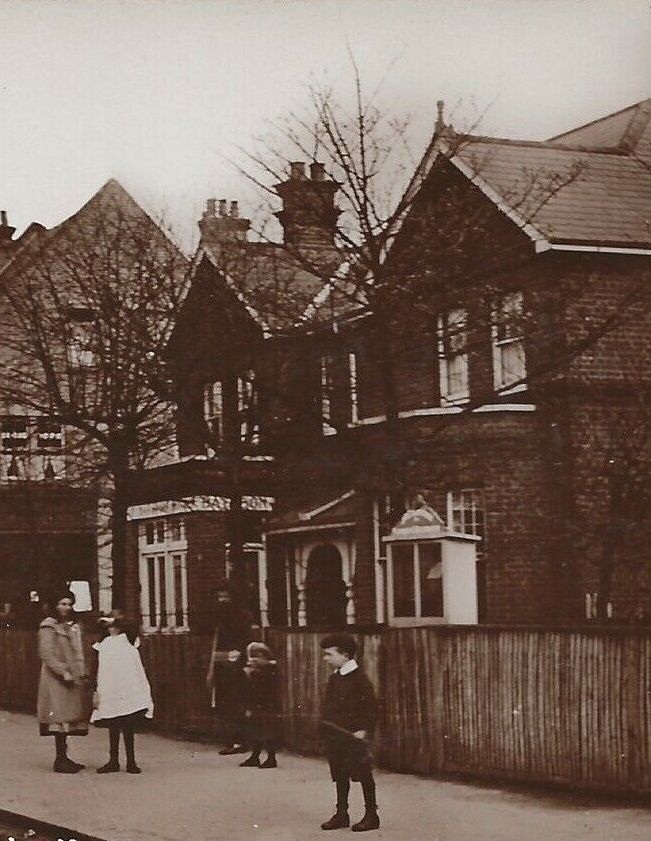
The adjacent Number 26 (initially known as “Meadow View”) was for many years a residential property with the occupiers respectively being a civil engineer in 1891, a customs officer in 1901 and a stockbroker’s managing clerk in 1911. Arthur Dale moved there from Gaynes Road around 1913, initially running a newsagent’s business from his front room, with the entrance through the front garden, surrounded by low fencing. By 1924 his previously cottage industry had expanded and his business was described as a “bookseller, stationer and tobacconist” selling “any brand of tobacco to order”. Dale also took orders for bookbinding, and received adverts for all local papers, and sold “local views, birthday cards, Stephen’s Inks, toys and fancy goods”.
After Arthur Dale’s death in August 1940 his business was acquired by the Irish-born David Alexander Ramsay, who already ran a newsagent’s business at 203 St Mary’s Lane. The fencing round the front garden was removed and a forecourt laid, with a modern shop front installed later. After Ramsay’s death in 1949 the business was run by his daughter Mary Lilian Mizen Ramsay (1913-2004), who had qualified as a midwife in 1936. By the 1990s the occupiers Martin McColls operated from an enlarged ground floor which included a sub-Post Office, later transferred next door. This premises now survives as Caffe Nero.
The southerly pair, known as “Oakhurst” (number 22) and the adjoining “Elmhurst” (number 24), were leased by William Hook. In around 1899 John Richard Caldecourt and his wife Lilly and their family moved from Hammersmith to establish a Master plumber and glazier’s business at “Elmhurst”, which had previously been a large residential property. After Caldecourt’s death in 1926, his son Ernie continued the business, concentrating on the plumbing trade, while another son, Ted, ran a decorator’s business from the same address. Ernie Caldecourt was still running the business from Elmhurst in 1937 but by 1939 the premises stood vacant until taken over by the Home Guard during the 1939-45 war.
William Hook occupied “Oakhurst” (Number 22) from the time that it was built in 1886 up to 1910 or earlier, with his builder’s yard at the rear running round the rear of Elmhurst. After William Hook moved to 1 Myrtle Cottage, Cranham Lane, A E (Albert Edward) Talbot set up his wheelwright’s business at “Oakhurst”. His older brother Harry, who had worked for Henry Joslin at Gaynes, had opened a greengrocer’s shop (later number 34) in the newly built Station Road parade around 1908.
Albert Talbot diversified from his original wheelwright business, adding bicycles and cars to its trade by 1922, and erecting petrol pumps on the forecourt. Talbots became a family firm when Albert’s sons, Albert, Leonard, Walter and Malcolm progressively joined their father in the business, which afterwards traded as A E Talbot and Sons. The firm’s founder died in February 1963, aged 82, outliving his wife Elizabeth by some ten years.
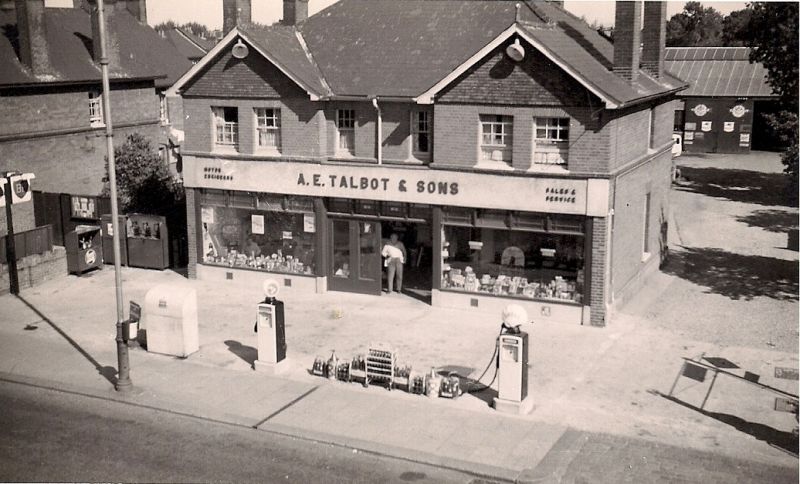
Talbot & Sons later expanded to include the neighbouring “Elmhurst”, after the Caldecourt family moved out, adding modern showrooms. Talbots concentrated on cars of the Rootes Group, which coincidently later came under the Talbot brand name, and in the 1990s as a Renault dealers and service centre. The business stopped selling petrol from the forecourt in 1996 and closed altogether in October 1998. In February 2000 the site was acquired by Roomes Stores, who developed a furniture store there which opened on 17 September 2001.
The next incursion into the Station Road frontage came in 1899 when Thomas Nathaniel Lavender, who had taken over the butchers’ shop at Cosy Corner in March 1887, transferred his business to his adjacent newly erected shop and five-bedroom premises, built by Hook and Wilson contractors, on a plot which Lavender had leased from the Branfill trustees since 1893. Outside were stables and a slaughterhouse, part of the original Cosy Corner butchers, and land running down to Cranham Road.
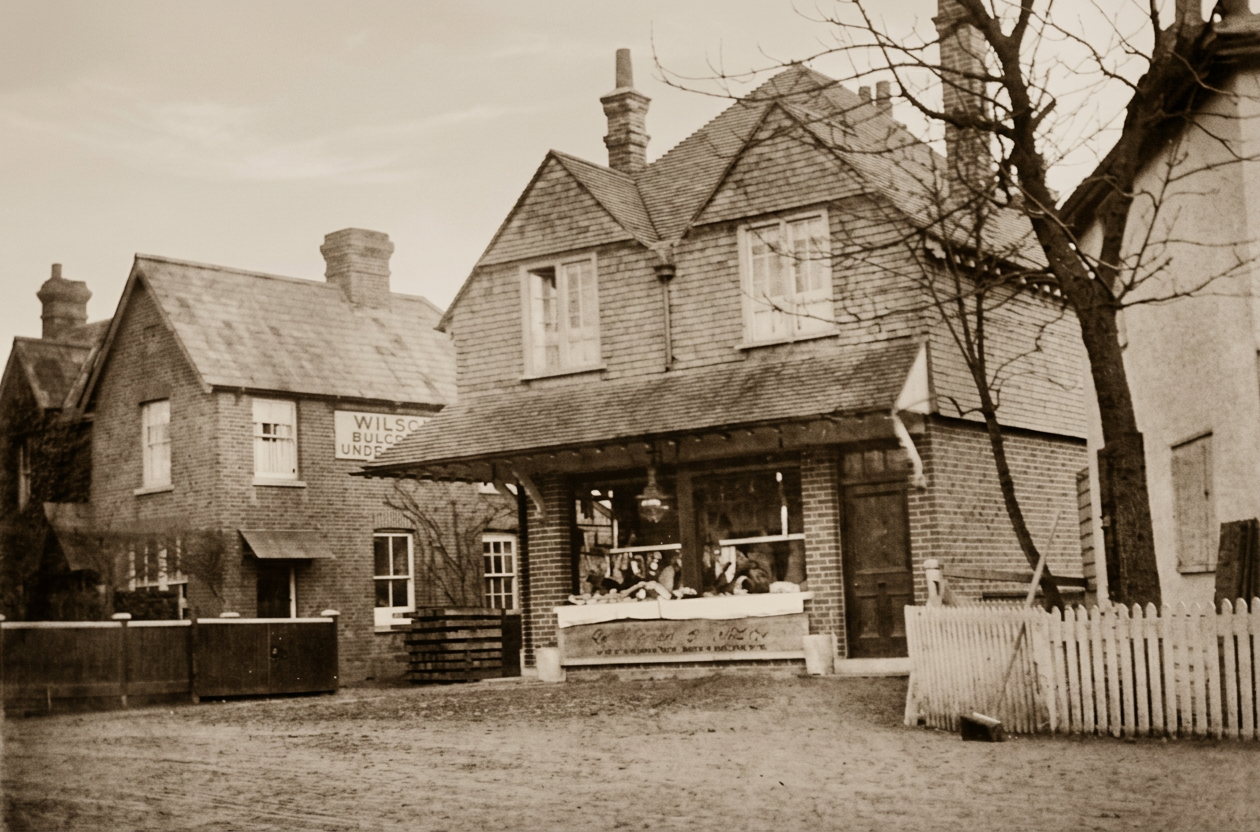
Lavender was succeeded in around 1910 by Charles Jupp (1857-1936) and after Charles’ retirement his son Leonard Jupp carried on the business of C W Jupp & Son until around 1930. The butchers’ shop was then converted to house the premises of Lloyds Bank under the management of Mr P H Whitney. Upstairs was a self-contained flat which Margaret Crabtree’s father Ronald Hewitson, a Lloyds bank employee, moved to with his family. Margaret wrote that the living room faced Station Road and Aggiss’s Chestnuts Garage, and the landing faced the school on St Mary’s Lane. She recalled that in the afternoon her “mother would make tea for the bank staff and hand cups through the bank coal hole at the side of the bank” which was also the hatch that “the staff had to shovel the coal through to replenish the bank fires”.
Lloyds Bank relocated their premises in the mid- 1940s to the new parade of shops which were built on the site of America Lodge at the rear of Cosy Corner.
The most significant changes to Station Road came from early 1907 with the development of the Upminster Garden Suburb by W P Griggs & Co, after they had acquired an initial 150 acres of the Upminster Hall Estate from the Branfill family in November 1906. William Peter Griggs (1849-1920) already had considerable experience as a builder and estate developer in Walthamstow, Wanstead, Leyton and Bexley before he developed the 200 acre Cranbrook Estate in Ilford from 1897 onwards.
From 1907 retail premises were built on the previously well-wooded frontage of Station Road between St Lawrence Road and Station Approach, originally numbered 1 to 18 but later renumbered 30 to 68 Station Road. The first retail properties to be built by Griggs & Co were Alfred Wooffs dining rooms at number 30 and Miss Rhoda Leaney’s confectioners, next door at 32 (originally numbers 1 and 2) which were built northwards from the corner of St Lawrence Road.
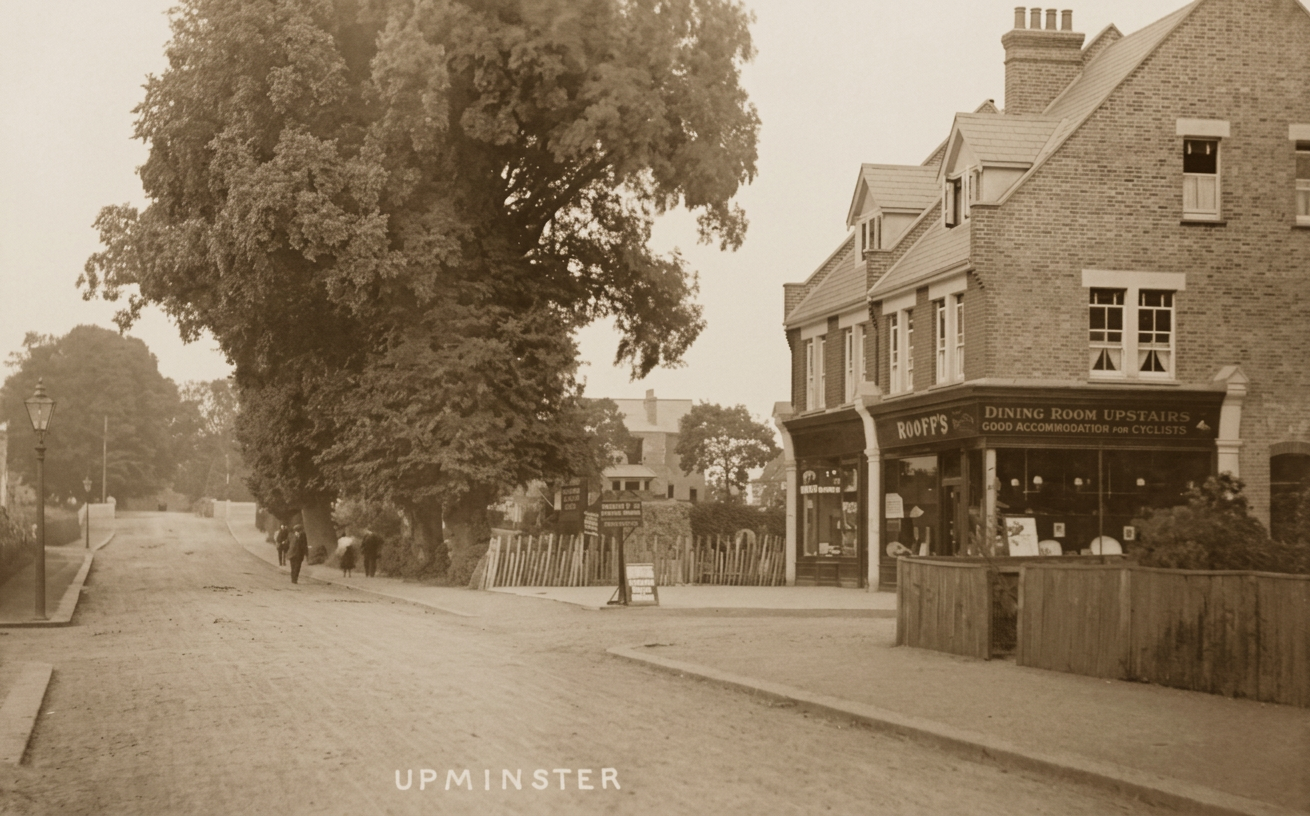
These were followed later in 1907 by the properties from number 34 to 54 (originally 3 to 13) up to the newly laid out Howard Road, starting with Harry Talbot’s greengrocers (34) and Horace Spear’s fishmonger (36), with Searson Brothers boot and shoe dealers at Number 38 opening early in 1908. Also towards the end of 1907 Henry Copley submitted plans to build an ironmongers at Number 52, with plans for Charles Davis’s tailors at 48 and Frank Kemp’s original Crumpled Horn dairy at Number 50 soon following.
The parade north of Howard Road up to the Station Approach (initially numbers 14 to 18 but later renumbered 62 to 68) was also developed from the summer of 1907 onwards. Unlike most of the parade between St Lawrence Road and Howard Road these plots and shops were owned privately, rather than Griggs & Co, with plans brought forward on behalf of their owners by George Verlyck of Ilford, who was employed as Griggs & Co’s main architect.
Georges Louis Marie Edouard Verlyck (1863-1936) was a colourful character, who trained as an architect in his birthplace, Paris. He was said to have served in the French Foreign Legion between 1884 and 1889 before deserting after striking an officer. After spending some time in Italy he came to England in around 1893 and settled in Ilford. He soon established a successful architect’s business in partnership with Edwin Dunn until 1901, and he was involved in the design and building of Griggs & Co’s Cranbrook Estate.
The Upminster shops that Verlyck was involved with were Cox’s butchers (No 62), developed from the summer of 1907, Ernest Bramwell Humphrey’s Chemist (64) later that year, with the bakers – originally Arnold Cable but later Frizzell’s (66) and the Off Licence owned by Taylor Walker and operated by Joseph Turner, (68) developed from summer 1908. These businesses were unusual in that they remained in the same trade from the outset for around 90 years, right through to the closure of Dyer’s butchers’ shop at No 62 and the closure of Kingcott’s bakers after 23 years in January 2019. Today only the Chemist (now Govani) and the off licence (VSP Wines) have continued in the same trade.
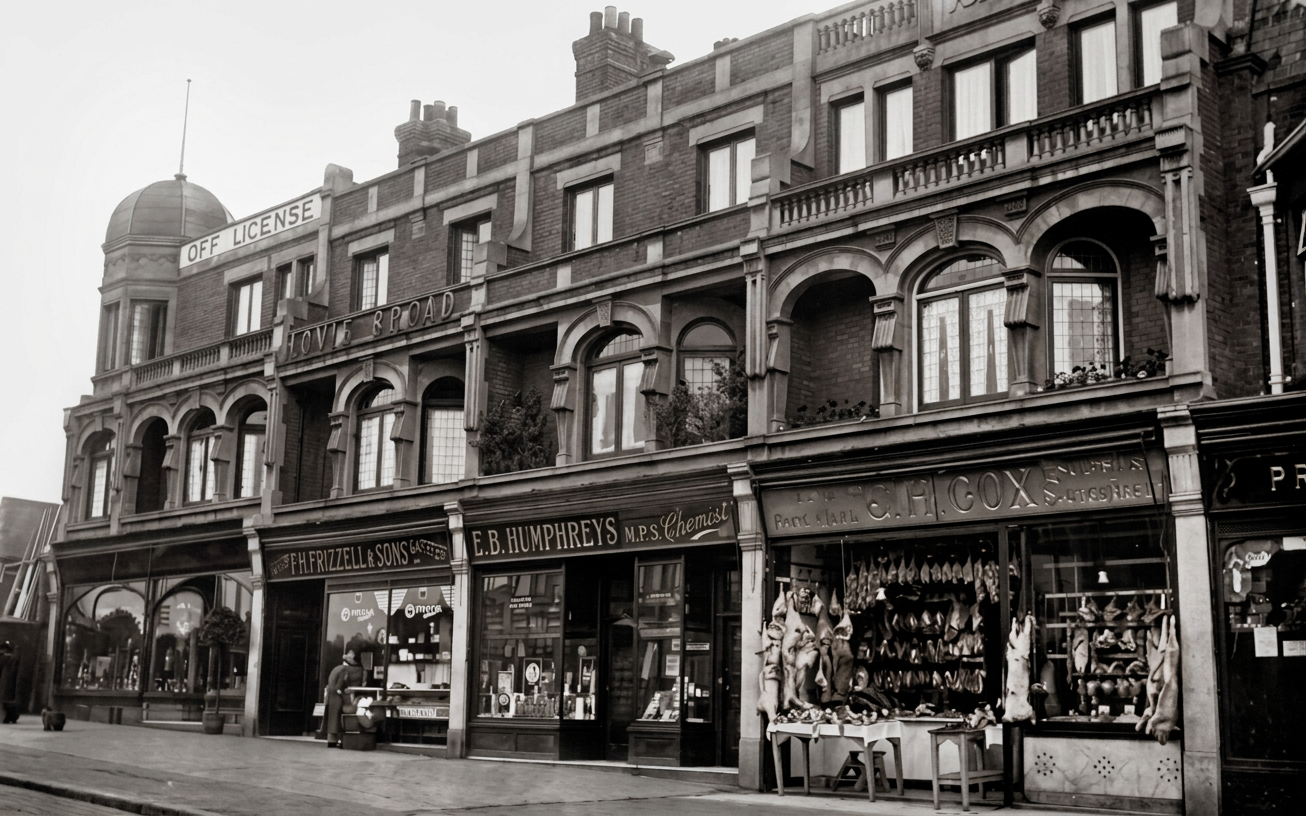
Harry Frizzell, who took over as the master baker at number 66, had an interesting background. Born in Dorset in 1868, he was baker in Wales from his marriage in 1889, where four children were born, and in around 1906 he relocated to Kent and became a missionary for the Society of Friends in Rochester, moving to Upminster to take over the bakers in early 1913 assisted in the business by his daughter and sons. When the Branfill trustees sold their remaining Upminster estates in 1921 Frizzell acquired America Lodge and land behind Cosy Corner and down Cranham Road (St Mary’s Lane) which was developed from 1928 onwards. After Frizzell’s death in February 1933, his son Howard carried on the bakers’ business for many years.
The site on the corner of Station Road and the Station Approach was owned by the railway company, rather than Griggs & Co. It was developed as a nursery and florists, which from photographic evidence, was there from at least 1912, or earlier. Alfred Rendle, an Enfield-born nurseryman, seems to have established a lock-up florists and nursery on this site (numbered 70 Station Road) as an outlet for his nursery in Nags Head Lane. Alfred had learnt his trade working for his father John who was a nurseryman, seedsman and florist in Seven Kings, Ilford.
Rendle was succeeded around 1927 by Herbert Stanley Pudney (known as Stanley), a Fellow of the Royal Horticultural Society, who lived for many years with his wife Mabel and family at 27 Howard Road. Pudney’s nursery remained as a well-known Upminster business for well over 30 years, into the early 1960s.
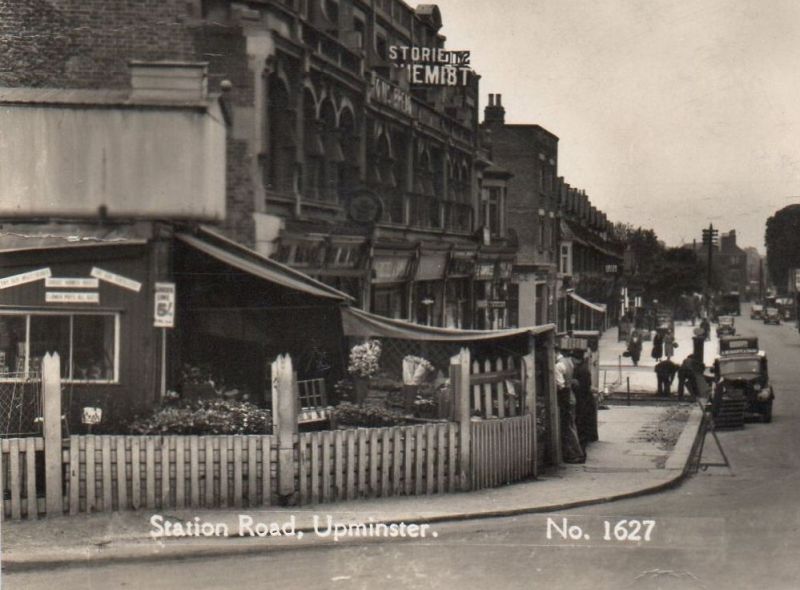
The Essex Yeoman opened on the former nursery site on 19 April 1968. It’s not clear how the brewers Truman chose the name, but the choice was reflected in the decorations and the first point was pulled by Col G R Judd, the Honorary Colonel of the Essex Yeomanry, who performed the opening ceremony. By now owned by Greene King, the Essex Yeoman closed its doors on Sunday 11 October 2015,for a complete make-over and reopened at 11am on Wednesday 28 October 2015 with a completely new name – The Junction.
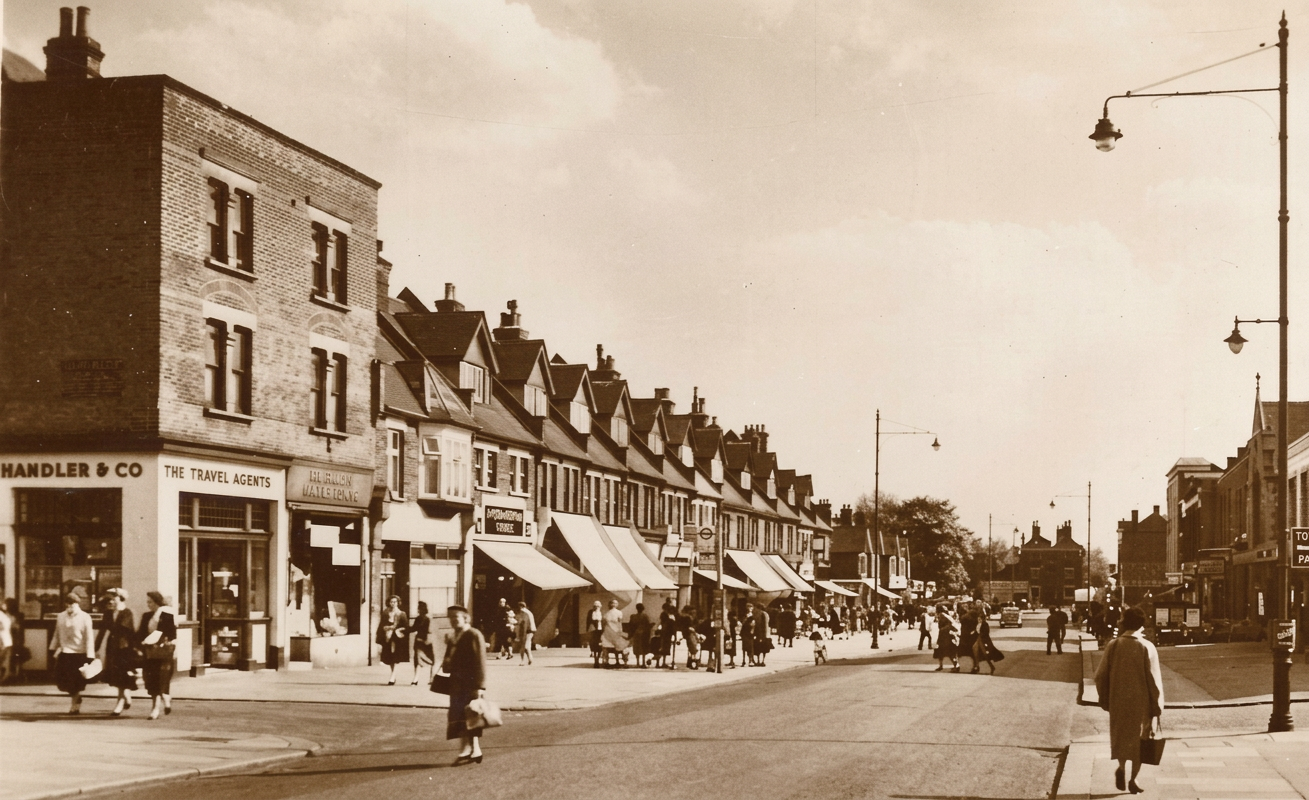
The remaining property on this side of Station Road, on the southern corner of Howard Road facing Gooderham’s, was the Bon Marche drapers (originally number 13 but later renumbered 54) developed by the owner William Atkinson Newell from early 1908. Ulsterman Newell seems to have been a Jekyll and Hyde character. Newell, the proprietor of a drapers already named Bon Marche in Southend, came to Upminster in November 1903 and leased the newly built Clareville (later Number 43), Champion Road. Four years later, as part of the Garden Suburb development of Station Road, Newell acquired the prominent corner plot, gaining planning approval in early 1908. He appears to have personally project managed the building of his Upminster shop which was completed in under six months by the end of September 1908. However, as Newell prepared for the shop’s opening, recruiting staff and ordering stock, he was taken ill with influenza on Christmas Day 1908, passing away five days later, aged just 48, after he developed pneumonia.
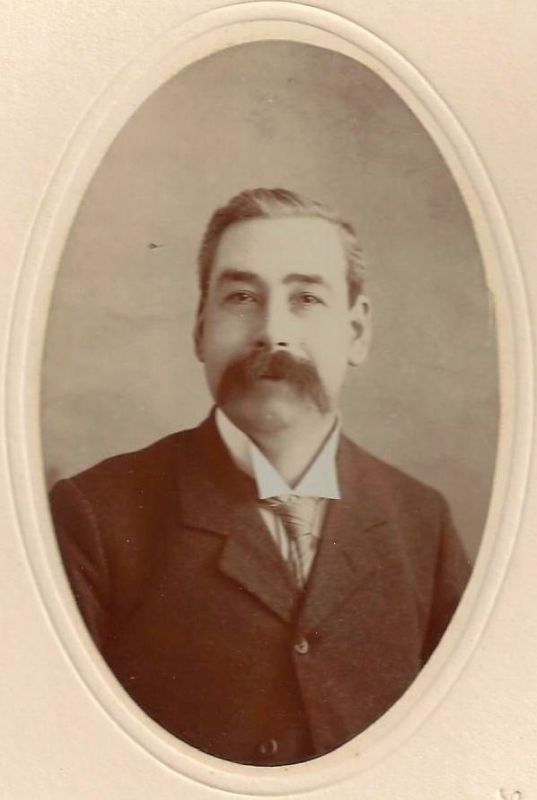
Newell’s obituary painted a glowing character reference of a well-respected resident, a prominent Freemason and founder member of the new Ingrebourne Lodge, who engaged in philanthropic activities in Upminster. Although his gravestone in St Laurence Church says that he was “Beloved by all who knew him” research into his life paints a different picture. In 1899 his wife Mary Ann Robb Newell had successfully petitioned for separation on the grounds of his “habits of intoxication” and cruelty and violence towards her. Reconciliations and promises to mend his ways were short-lived and the couple separated again in 1900. The following year Newell tricked his wife and took their two sons to stay at his mother’s home in Ireland. He then placed them in a boarding school in Bexhill where they remained after further court action gave his wife reasonable access.
It appears that in October 1903 Mary Ann had a breakdown and was admitted to an asylum in Camberwell, transferring to the Warley Asylum in November 1904. Her medical records indicate that she had first suffered seven years earlier, probably around the time of the birth of her second son. In 1921 Mary Ann Robb Newell was an inmate at Severalls Mental Hospital, Colchester where she died in November 1926, aged 57. Her eldest son William Atkinson Newell junior was by then running the Southend Bon Marche.
The Upminster Bon Marche opened at the end of 1908 and within a few years it became Percy Chichester Goodchild’s drapers, which it remained until the early 1930s. The store was then converted into two shops (renumbered 54 and 56) with Number 54 housing Ernest Selby’s Estate Agents, who transferred from Station Approach in 1935, while in 1934 number 56 became the premises of the County of London Supply Company (CLESCO) which post-war moved to Corbets Tey Road.
Harry Chandler (1913-1992), who had started his travel agents from his West Ham home in 1936 and continued the business after his move to Springfield Court, Upminster, later acquired Numbers 54 and 56. He restored the two shops into a single unit to house the growing business, adding a large extension to the rear. From the early 1960s, Chandler’s Travel Club of Upminster was one of the British pioneer companies offering package holidays on chartered flights, initially to Portugal but later expanding to offer Greece and the Balearic Islands as destinations, becoming one of Britain’s major travel operators. Later run by Harry’s son Paul, the Travel Club continued until its demise in 2010 after which the premises was taken over by the next-door solicitors Pinney Talfourd, formerly Pinney Rogers, formed from the merger of Pinney & Co with Ashby Rogers & Co who had operated at number 52 since 1950. Number 52 had previously been the ironmongers operated by Henry Albert Copley (1869-1954) for well over 40 years, from its opening in 1908.
For the west side of Station Road see Station Road West and the Branfill Park Estate
Sources and References
Printed sources:
T L Wilson “History and Topography of Upminster” (1881) p.126-128
Tony Benton with Albert Parish “Upminster: the Story of a Garden Suburb” (1996) in particular the chapters “Lanes of elm and oak: Upminster – an Edwardian garden suburb” (pp17-28) and “Station Road and its traders – east side” (pp85-106).
Margaret Crabtree “Growing up in North Ockendon and Upminster” (1996)
Gordon Lane “Georges Verlyck” in Chinook (journal of the Alberta Family History Society December 2024 (p3 & 4)
Archive Sources:
Essex Record Office
House for Mr Wilson, Upminster 1867 (D/F 8/660)
Proposed additions to Mr Lavender’s premises, Upminster Hall Estate (D/F 8/933/ 1 – 4)
Havering Local Studies:
Upminster Rate Books & Romford Rural District Council and Hornchurch Urban District Council – Building Registers
The National Archives
The Valuation Office Survey (1910-1915): IR 58/38464-5838474
Census Returns (1861-1921) & 1939 Register (via Ancestry & Find My Past)
Naturalisation papers: George Louis Marie Edouard Verlyck (June 1900) – HO 144/438/B29025 & HO 334/30/11559

