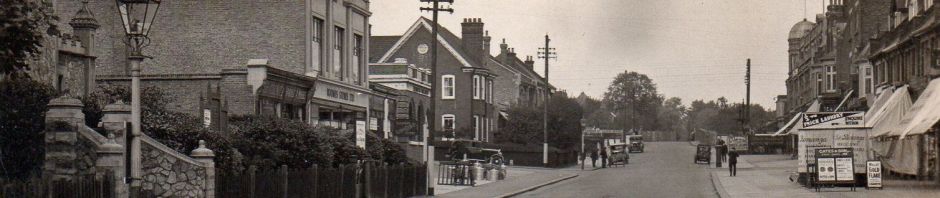
Until the first decade of the nineteenth century, there were no buildings on the west side of what was then called Hall Lane (later Station Road) northwards from what was later known as Chestnuts Corner up to what was the London to Pitsea railway, which opened in 1885.
From the evidence of Upminster’s rate books, the first building on the west side was almost certainly erected between April 1803, when James Nokes acquired part of the Bridge House Farm estate, and his completion of Upminster’s windmill in the Autumn of 1805. This was the house and bakehouse occupied by James Tunbridge whose name first appears in the parish rate book from July 1806 and was listed as a rate payer until 1825 after which Charles Woodward (1784-1864) succeeded him.
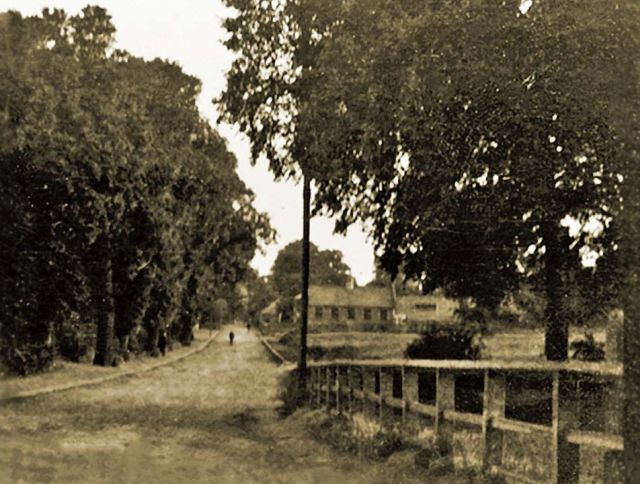
Woodward was the baker there until the 21-year old Josiah Ketley (often spelt Kitley) took over just after his marriage in 1838. In early 1847 Ketley’s tenure came to an unfortunate end when, described as a “baker, dealer in coals, wood & potatoes”, he was declared insolvent with debts of £181, of which £112 was owed to Thomas Nokes. The premises was described in July 1849 as being a brick-built “baker’s shop, with about an 8-bushel oven, good gardens and orchard and a very considerable building frontage to two high roads, one to Romford, the other to Brook Street and Brentwood”. It’s unclear who succeeded Ketley but the bakery and attached house gardens and orchards were already said in July 1849 to be “let to good tenants, producing about £30 per annum”.
The adjacent house on the bakery’s north side had been let since at least 1817 to James Ambrose, a Norfolk-born gardener, who was already living in Upminster when he married Sarah Wicks at St Laurence Church in 1801.
When the bakery and adjacent house were auctioned in 1849 these two houses and the associated site of under an acre were part of an auction lot which also included a meadow of around 11 acres to the north, along Hall Lane, and along Hornchurch Road to the west. This lot was purchased by Edward Dawson of Aldcliffe Hall, Lancashire, from a prominent nonconformist family who were acquaintances of the Claytons, the owners of Gaynes Park.
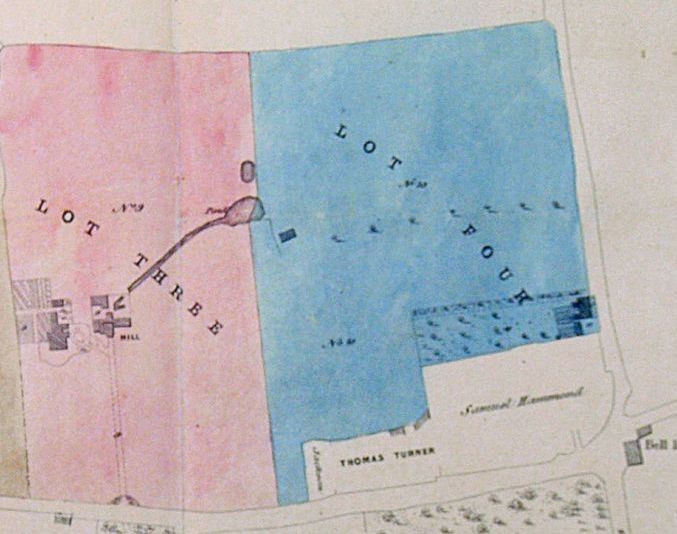
In 1851 the bakehouse was occupied by John Copsey, a Hornchurch-born baker and pork butcher, who had married in Upminster in 1839. Edward Dawson sold both these properties in 1856 to Henrietta Davies, the sister of George Eve, the owner of Foxhall at Corbets Tey.
Edward Hitch, who had worked as a baker’s journeyman in Chadwell Heath, was at the Upminster bakehouse in 1871 where he was described as baker and corn dealer employing two boys. Edwin Battson, pork butcher occupied the adjacent house. In May 1875 both properties were conveyed by Mrs Davies to Edward Hitch, who continued the bakery business until his death in 1888.
After Hitch’s death James Staines, the son of a Dunmow baker, occupied the bakehouse for the next 20 years, until he was succeeded by Sidney Abraham, who was married to Edward Hitch’s daughter Florence. Sidney, who was the younger brother of Thomas, Alfred and Clement Abraham who ran the Upminster Mill and related businesses, had run a bakers near the Masons Arms in Cranham Road. After taking over the Station Road bakery Abraham continued to employ James Staines until the latter emigrated to Canada in 1913.
When Sidney Abraham died in 1935 his surviving son Albert (Bert) succeeded him, as Sidney’s eldest son, also named Sidney, had sadly died of his wounds in a German prisoner of war camp in May 1918. When Bert’s mother Florence died in 1950, a clause in her father Edward Hitch’s will required the bakery to be sold. Hornchurch Council bought the premises at auction in March 1952, and the proceeds were shared between Florence’s children, Bert and his two sisters Grace and Florence. Abraham received a notice to quit the premises by September 1952. After he was unable to find employment as a baker, he sadly drowned himself at Baldwins Gravel Pits, North Ockendon in July 1952, aged 50.
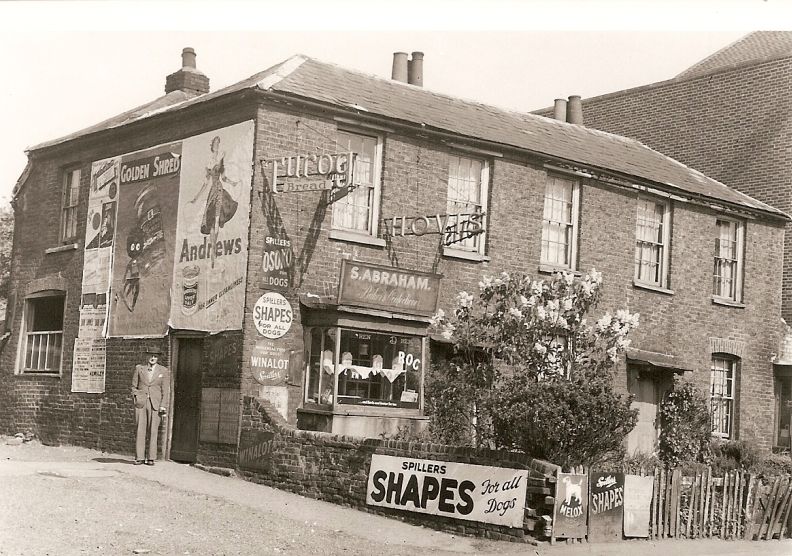
In 1939 the cottage adjacent to the bakery was occupied by Sidney Olley, Abraham’s assistant. John Cant operated a boot repair business from an extension to the north side from at least 1914 through the 1920s until his premature death aged 41 in 1936. The Bakery and adjacent buildings were demolished in 1953 and Essex House was subsequently erected (numbers 15, 17 and 19 Station Road). The land to the rear was incorporated with the car park.
The British School
After acquiring part of the Bridge House estate in 1849 Edward Dawson presented a site on Hall Lane, north of the bakery, to the proposers who were seeking to establish a school in Upminster on the British and Foreign School Society model, favoured by Nonconformists. In May 1850 a meeting chaired by the Rev John Clayton formally set up a management committee for the “Upminster British School” and opened an appeal for subscriptions to build and run it. Thomas Johnson of Gaynes Villa was a principal subscriber to the project, and his wife Mary, daughter of the late Rev John Clayton, laid the first stone on 26 September 1850. The school, built by William Hook, opened for pupils just five months later. The first headteacher Miss Elizabeth Treble, who was paid a salary of £40 per year, remained as head until she married David Pinchon, the miller at Upminster Common, in 1860.
The school continued to operate as a “British School” until 1885 when it merged with the National School opposite to form the Upminster Board School. The British School building was reorganised to house the girls’ and infants school, while the National School premises opposite housed the boys.
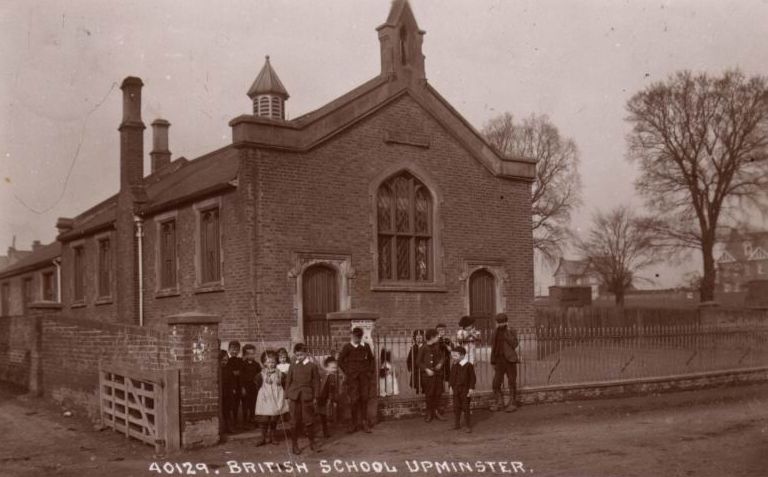
The growth in Upminster’s population in the twentieth century required more school places. When the Upminster Council School opened in 1927 the British School building was surplus to requirements, although it was initially kept in use as cookery facility. In 1936 the Essex Education Committee handed the premises back to the British School Trustees, who in March 1937 received the agreement of the Board of Education to sell the site, which fetched £6,400 at public auction later that year. The school building was demolished in January 1938 and four shops and flats were developed on the site for the new owners Messrs Williams Brothers by Messrs J Cotton, builders. Although these premises were completed in May 1938 it is thought that the new shops (numbers 21, 23, 25 and 27 Station Road) only opened after World War Two.
The Branfill Park Estate
The lands that were developed as the Branfill Park Estate had originally been part of the Bridge House Farm estate, which also included the bakers and the adjoining premises, which was sold at auction in July 1849.
It appears that the 11 acre meadow, which was part of the estate bought in 1849, was broken up and sold before 1868. Part of this was acquired by Mrs Branfill of Upminster Hall, who in her will dated 26 March 1868, bequeathed a five and a half acre site along Hall Lane, adjoining the British School, to her son Col Brydges Branfill (1833-1905), who inherited it on her death in November 1873. Two months earlier in September 1873 Col Branfill bought from the widow of Thomas Turner adjacent lands of almost six acres which ran north from Mavisbank, which had also been part of the Bridge House Estate. During Col Branfill’s ownership Mavisbank was successively let to tenants and the meadow was separately let to Edward Battson for grazing.
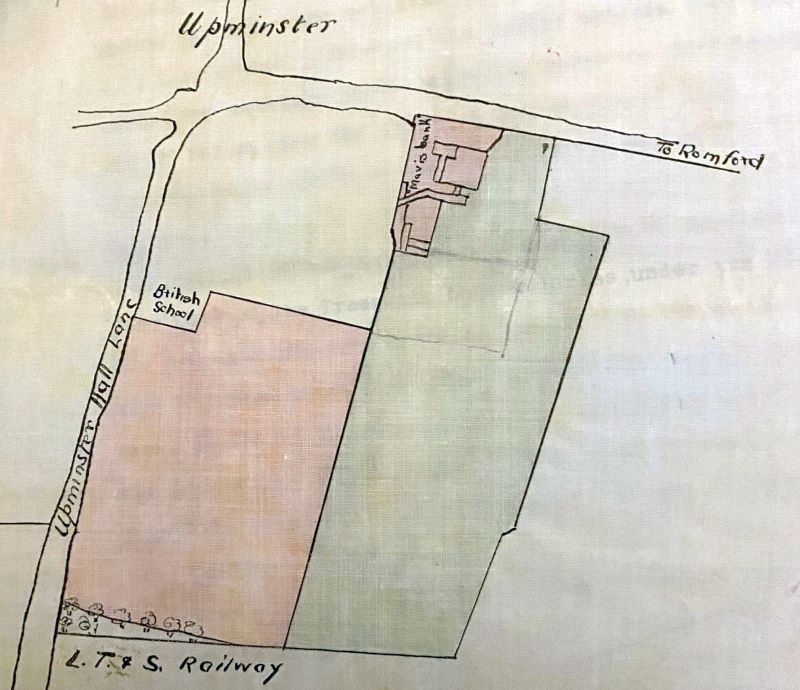
(Brentwood Diocesan Archives)
In February 1902 Col Branfill sold Mavisbank and its adjoining lands to Dowsing and Davis, builders of Romford. James Everitt Dowsing (1851-1922) and Samuel Davis (1848-1926), ran their successful business from their yard in Mawney Road, Romford.
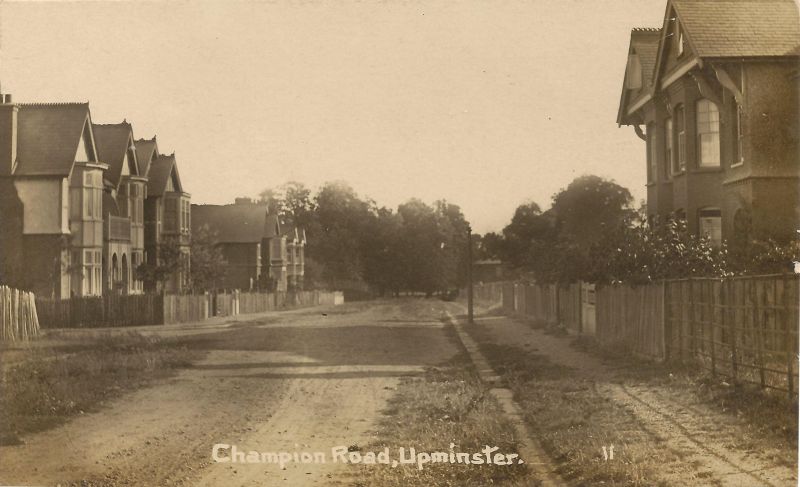
Dowsing was born in Romford, the son of Herbert Dowsing, a Suffolk-born plumber and decorator. He trained as a carpenter and branched out as a builder, setting up in business around 1880, and a few years later he was joined by Samuel Davis, a Hatfield Peverel-born bricklayer. They founded the firm of Dowsing & Davis which was engaged in building the Eastbury Estate in Romford, much of the Mawney Estate and parts of Hornchurch before they acquired Col Branfill’s estate to develop the first housing development in Upminster. Naming the development Branfill Park, they laid out roads named Branfill Road, Champion Road and Gaynes Road.
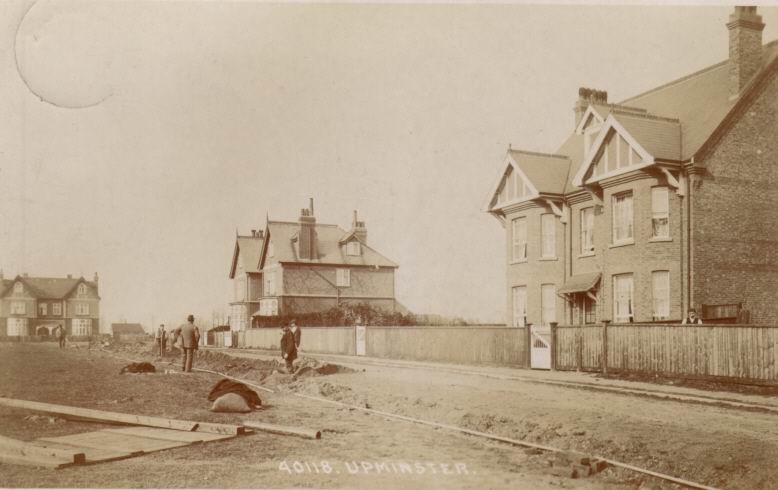
In April 1903 Dowsing & Davis submitted plans to build 12 houses on the south side of Gaynes Road (numbers 1 to 23), two houses in Champion Road (Number 43 “Clareville” & 45 “Branfill”) and four houses in Branfill Road, with three more houses following in the next two years. It was over three years before more houses were added with plans for 10 houses in Champion Road submitted in January 1909 and for more house in Champion Road following over the next six months. These proposed houses in 1909 were the final houses planned by Dowsing & Davis, as they seem to have run into problems in completing their plans, and sold the houses and undeveloped sites to W P Griggs and Co soon after.
From September 1911 onwards Griggs & Co brought forward plans to complete the Branfill Park Estate, with 10 houses, numbers 2 to 20, on the north side of Gaynes Road, from the Congregational church to Champion Road, completed between November 1911 and February 1913. The east side of Champion Road from Gaynes Road to Branfill Road was then developed with nine houses (numbers 22 to 38) built in 1913 and 1914, followed by three houses on the west side, numbers 1, 3 and 5, built in Branfill Road in 1915. Griggs’ final building works on the estate were sixteen houses built in Champion Road, numbers 1 to 23 and 35 to 41, in 1915 and 1916.
When the Branfill Park Estate was being developed from 1903 onwards, the village grocer W J Gooderham probably acquired the site on the corner of south side of Gaynes Road and Station Road which was earmarked as a site for a new shop. However Gooderham gave up his business in 1916 and this site remained undeveloped until the summer of 1924 when on 22 May 1924 he sold the site to Harry John Sexton of Lorne Road, Forest Gate and on 28 July 1924 plans were submitted to build a branch of Barclays Bank there (29 Station Road). This was probably completed in early 1925.
The Barclays Bank branch continued to occupy the site for almost a hundred years until its closure on 29 May 2020. Plans to add two floors to the building and construct six flats were approved in October 2021 and work was completed early in 2024. The ground floor unit now houses a children’s nursery.
The Congregational Church (now the Trinity United Reform Church)
The growth in Upminster’s population after the development of the garden suburb meant that the Congregational Chapel on Upminster Hill was too small for its congregation and was not suitable for further expansion. By January 1909 a site for a new church had been acquired on the north corner of Gaynes Road and Station Road at a cost of £500 and fundraising efforts began. A Building Committee was set up before the end of the year with one of the Church’s deacons William Ashby, a solicitor of Engayne Gardens, the building fund’s secretary. The estimated building cost of the new church was £3,500, half of which had been raised or pledged by July 1910, allowing plans to be submitted to the local authority for a church with a capacity of 400, designed Mr T Stevens, and built by H J Carter of Grays. The laying of the memorial stone, which contained a casket holding a newspaper, a copy of the order of proceedings and plan of the church, took place on 18 October 1910 at a ceremony carried out by Henry Joslin of Gaynes Park. The new buildings were formally opened on 29 March 1911 allowing the chapel on the hill to be sold.
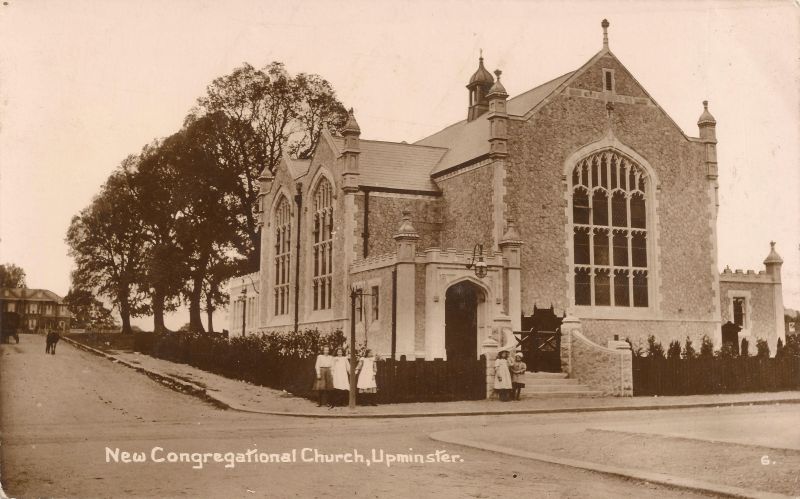
In 1923 the church premises were extended when a church hall, the Commemoration Hall, with seated accommodation for about 350, was added at a cost of £2,700 including furnishings. The foundation stone was laid by Lady Griggs in February 1923, and the hall was formally opened three months later at the end of May. Two weeks later Lady Griggs presented a stained glass window at the back of the church, in memory of her late husband, Sir Peter Griggs who had died in 1920.
As early as 1935 another hall had been planned on land north of the church, close to Roomes, but a decision to build this was only made after the war. The hall, built in 1947, was later named in honour of Rev Robert Roope, the church’s minister from 1940 to 1951.
The Roomes Store site (41 to 49 Station Road)
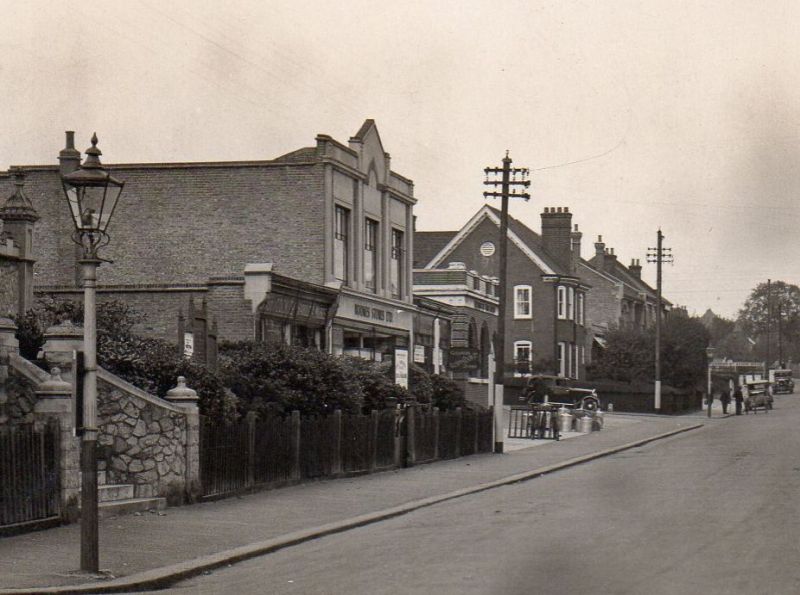
The first development on what was later the site of Roomes Store came in October 1924 when Lush & Cook Ltd, a well-established firm of dyers and cleaners of Hackney Wick, applied to develop a single-storey lock-up shop to the north of the church site at 41 Station Road, to add to their expanding chain of premises across east London. Lush & Cook seem to have continued at that address until April 1936. A branch of Harold Mobbs hairdressers, whose main business was at Manor Park, occupied the adjacent 43 Station Road.
In 1926 the 40 foot site to the north of Lush & Cook was acquired by the newly formed Roomes Stores Ltd, which been established with the financial backing of William Donald Key (the architect son of William Garbutt Key, director of Upminster Estates) and Frank Norledge, a civil servant who lived in St Mary’s Lane, Upminster. The Roome family, who had owned a drapers store in Green Street, Upton Park since 1888, had lived in Upminster since 1908.
In March 1927 Roomes applied to build a new drapery store on the Station Road site, which was completed by the start of November that year and opened with a staff of 15. In 1930 Roome Stores acquired the 25 foot frontage to the north and their plans for an extension to house a furnishing department were approved at the start of August 1931 and the works were completed just before Christmas that year.
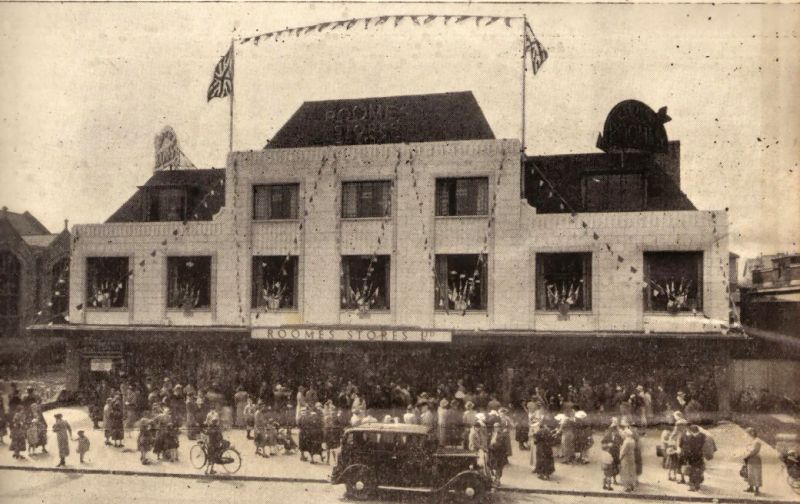
In 1934 Roomes acquired further adjacent land and developed plans to concentrate their efforts at Upminster, closing their Upton Park store in January 1936, Roomes Upton Park store was closed, finalising plans to rebuild the Upminster Station Road store. The new store, which had a 93 foot frontage, was designed by WD Key and built by Wilsons of South Ockendon. The ground floor offered drapery, ladies’ wear, millinery haberdashery and a perfumery, the first floor furniture, carpets, hardware, including household utensils, garden furniture, china, and glass, and the second floor the cafe and restaurant and an oak panelled board room. The store remained open during the year-long expansion, at times without a roof or walls. The ceremonial opening on Tuesday 4 May 1937, eight days before the coronation of George VI, was performed by the Mrs Elizabeth Key, widow of William Garbutt Key, the leading light in the development of the Upminster Garden suburb.
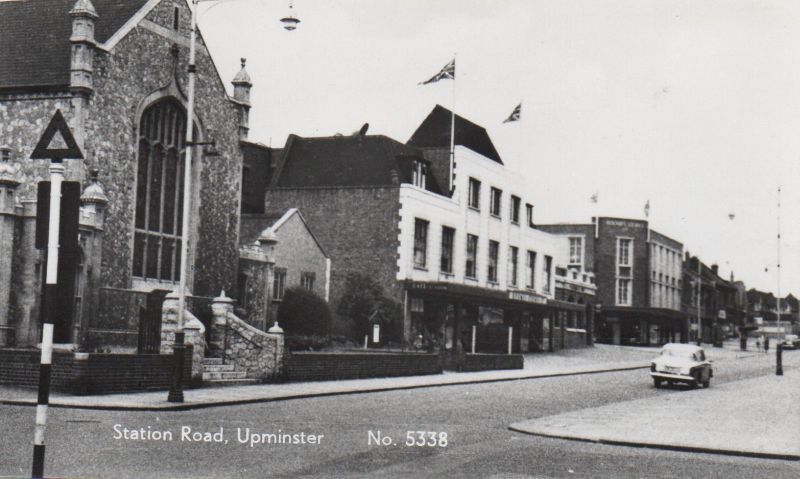
In around 1906 the London County and Westminster Bank acquired the site at the junction of Branfill Road and Station Road, part of the Branfill Park Estate. Plans were submitted to build a sub-branch in October 1913, and Upminster’s first bank opened early the following year, under the management of Mr L Selby. The branch initially opened for a few hours each Monday and Thursday, before operating on a full time basis before 1922. The bank company shortened their name to the Westminster Bank Ltd in 1923. The branch remained in that location (49 Station Road) next to the main Roomes store until after 1967. After the National School building on the opposite side of Station Road was demolished in 1967 Roomes acquired the former school site and struck a land-transfer deal which allowed the Westminster Bank to relocate to a newly-erected bank building on the other side of the road (8 Station Road).
Roomes adapted the vacated Westminster Bank building as a book shop. It was demolished in 1972 and was replaced by a ground-floor only extension of Roomes, accommodating the leather, stationery and book departments, with access to the main store. This extension was demolished in May 1989 and replaced by a new three-storey building which was completed in October 1990 and remains part of the Roomes Store which now occupies numbers 41 to 49 Station Road.
North of Branfill Road
The house at the northern junction of Branfill Road and Station Road (“Parkbury”, no. 51 Station Road) was built in 1908 for Francis Ferriman Bletsoe, a dentist and chemist who leased it to his nephew Dr John Henry Bletsoe (1882-1962). The Bletsoe family were from Kimbolton, Huntingdonshire where Dr Bletsoe’s grandfather Francis Blunkitt Bletsoe was a farmer of over 300 acres.
Dr Bletsoe was born in Richmond, Surrey in 1881, the son of John Bletsoe a Chemist and Druggist. He attended St Paul’s School before training as a doctor at St Thomas’s Hospital where he qualified in 1904. In 1906 he went into partnership with Dr Wagstaff in Hornchurch, moving to the newly built Parkbury in 1908. He joined in partnership with Dr Arthur Sanderson before 1912 and by the early 1920s he was in partnership with Harold Shillito Robinson as Bletsoe and Robinson. Dr Henry Wilfred Lee Nichols had joined them by 1926 and Dr Cecil Hearle Symons had joined the partnership before 1929, with his surgery at Abingdon, 16 Hall Lane, at the junction with Deyncourt Gardens (now the site of Abingdon Court).
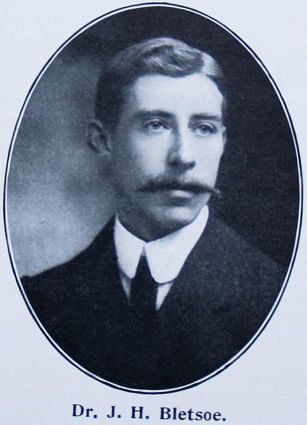
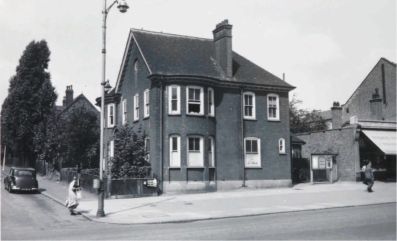
Former Bletsoe residence “Parkbury” c.1950 (Image: Roome Family)
Dr John Bletsoe was a keen sportsman, representing St Thomas’s Hospital at rugby in 1901-02 and in swimming in 1903-04, and he was later also said to be a keen golfer, who captained Thorndon Park Golf Club. After 30 years’ service to Upminster Dr Bletsoe retired to Hawkhurst, Kent in 1938 with his wife Leila nee McHinch; the couple had no children. On the outbreak of war he assisted a local GP and after joining the Home Guard was promoted to Medical Officer. However, rheumatoid arthritis curtailed his activities soon afterwards.
After Dr Bletsoe’s retirement the doctor’s house on the corner of Branfill Road was bought by Roomes, but the war delayed any plans to develop the site. In 1955 the addition of further land in Branfill Road next to the doctor’s house allowed Roomes to progress plans to build on the site. Roomes furnishing store opened in the following year, with a top floor added in 1958.
The final redevelopment of the corner site came in 2007. In February 2000 Roomes Stores acquired the former site of Talbot’s Garage on the east side of Station Road (numbers 22 to 26) to develop a furniture store there, which opened on 17 September 2001. Subsequently, in September 2006 approval to demolish the former Roomes furniture store was received and the store was demolished in summer 2007 and a Marks and Spencer Simply Food Store was erected. The scheme, which also saw the erection of 14 two-bed apartments plus car parking and servicing space, was completed in Autumn 2008.
In August 1914 Georges Verlyck, who designed many properties for W H Griggs, applied on behalf of Griggs & Co to build a shop and dwelling in Station Road. This was completed by April 1915 and a dairy was added at the rear a few months later. This premises, the Crumpled Horn Dairy at Number 53, was operated by Frank Wilkins Kemp, who had since 1908 run a dairy at 11 Station Road (now number 50) from the parade’s opening. The Wiltshire born Frank Kemp had previously been a draughtsman, and it is unclear why he relocated to Upminster and made such a major career change – his wife Annie also does not seem to have had links to the dairy business. His move from the small shop to the larger new premises suggests that he was trading successfully.
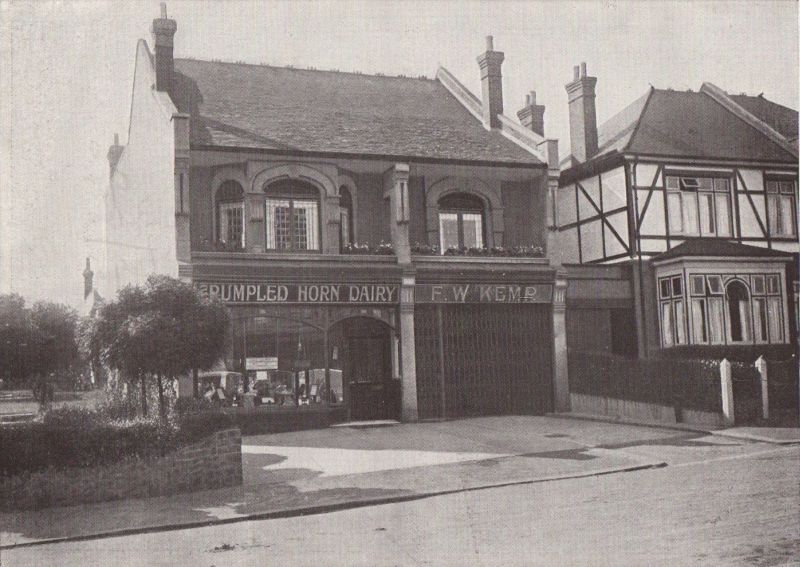
In 1922 Kemp’s Crumpled Horn Dairy advertised “Afternoon teas, cream and honey” and “new laid eggs direct from the farm”; “invalids’ and nursery milk in sealed bottles” as also offered. Four years later a similar advert additionally sold “grade “A” milk … under licence”. It appears that Kemp did not buy his stock from local farms as in 1919 he advertised in Marlborough, Wiltshire for new laid eggs to be supplied with all carriage paid, and boxes found, and in 1928 in a Gloucestershire paper for eggs to be supplied weekly at best London prices. Frank Kemp seems to have retired by the early 1930s, and the business was acquired by Clifford Buttle, who already operated several London dairies. He ran the establishment until 1938. The site became a Crown Post Office, post war, and after the post office transferred to the east side of Station Road in the early 1990s, numbers 55 & 57 became Daniel Ray’s photographic studios. These studios closed in May 2001 and after they were demolished in December 2003, were replaced by a M & Co clothing retail shop on the ground floor, with apartments above.
When WP Griggs and Co launched their plans for the Upminster Garden Suburb in November 1906, an early development was a pair of semi-detached houses (then numbered numbers 57 and 59). The southernmost property (Number 57, Lys House) became the family home of Joseph Gillings, a house decorator who was engaged to work on the new estate, moving from Ilford, where also worked for Griggs on his Cranbrook estate development, around The Drive. Prior to that Gillings worked for Mr Thomas Donald on the Woodgrange Estate, Forest Gate. Gillings founded the firm of Gillings & Sons in 1897 and expanded the business to work on the Upminster development. Joseph Gillings died in June 1924 after “a long and painful illness”, leaving a wife, four sons, and seven daughters. In the early 1930s the firm, renamed Gillings & Co, moved to 30 Station Road and soon afterwards Mrs Doris Boyle established her ladies hairdressing business there at the renumbered 61. The Station Pantry has occupied this address since around 2016.
The adjacent premises, originally numbered 59 but renumbered 63, not only served as Griggs’ estate office, marketing their newly-built houses on the Garden Suburb, but was also the home to Griggs’ general foreman, Arthur Charles Brandon (1865-1944) who lived there from 1911 or earlier with his wife and six children. As the Upminster building operations wound down in the 1930s the Upminster Estates office was no longer needed, and Brandon left in 1935. The premises was rented on a 21 year lease from August 1935 by Roomes Stores who used this as a men’s wear shop. It is now Balgores Estate Agents.
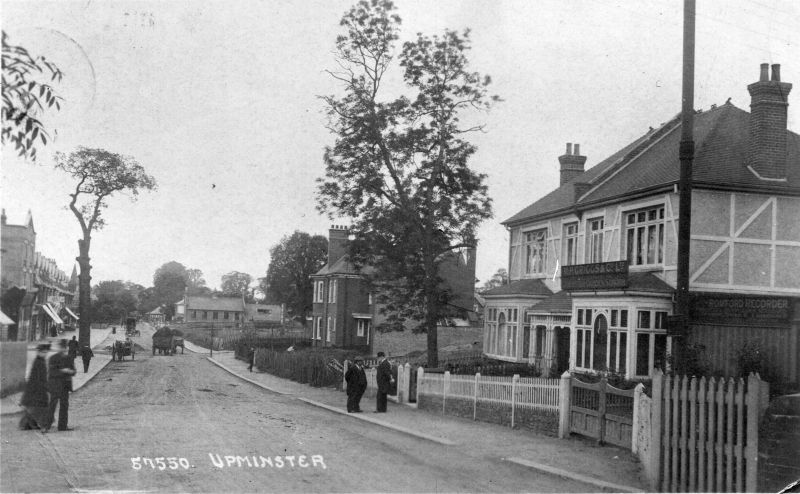
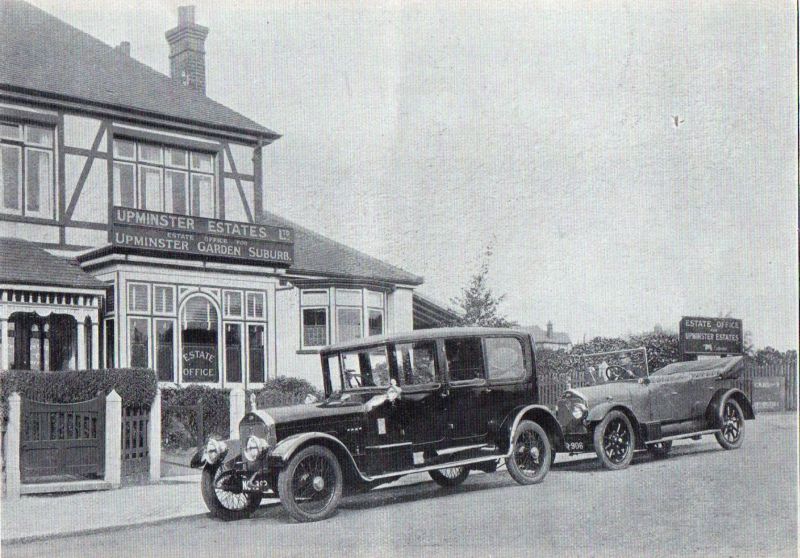
From around March 1934 Cakebread Robey & Co operated a builder’s merchants business in a house and the land adjoining the former Upminster Estates Office. Halo Hair Design has operated here for at least 15 years. “E” company 4th Essex Home Guard used this as their quartermaster’s stores from 1941 to 1944 and over the years a variety of short-term users have operated out of No. 67, including Euroneed Ltd a manufacturing carpenters for staircases, doors and flooring.
Sources and References
Printed sources:
T L Wilson “History and Topography of Upminster” (1881) p.126-128
Dorothy Hutchinson “The Story of Trinity” (1991)
Tony Benton with Albert Parish “Upminster: the Story of a Garden Suburb (1996)
Archive Sources:
Essex Record Office
Overseers’ Rates 1817-1827 (D/P 117/11/6-7)
Churchwardens’ Rates 1796-1827 (D/P 117/5/1) & 1827-1836 (D/P 117/5/2)
RC Diocese of Brentwood:
Property Deeds of Mavisbank (115 St Mary’s Lane)
Havering Local Studies:
Upminster Rate Books & Romford Rural District Council and Hornchurch Urban District Council – Building Registers
The National Archives
The Valuation Office Survey (1910-1915): IR 5838464-5838474
Census Returns (1871-1921) & 1939 Register (via Ancestry & Find My Past)


Pingback: Station Road East | Old Upminster