
In August 2013 I visited William Rose Holden at his home overlooking Hove Park. We had been in email contact for several years but I hadn’t managed to meet him on his occasional visits to Upminster. William was not only the Patron of the Upminster Rectorship but was the owner of the Holden family portraits, which used to hang in the Upminster Rectory. I had seen photographs of these portraits but at last I got the opportunity to see the originals.
Sadly William Rose Holden died aged 90 in January this year (2025). Although my pleasant visit to his home 12 years ago was only short, it provided me with a personal connection to a remarkable unbroken sequence of almost two hundred years when five successive members of the Holden family served as Upminster’s Rectors, starting with the appointment of Rev John Rose Holden the elder in 1780 and ending with the retirement in 1971 of William Holden’s uncle, the Rev Hyla Rose Holden.
The Holden connection with Upminster dates from the purchase in 1780 or shortly earlier by William Holden a Birmingham merchant of the advowson of Upminster – the right to present to candidates to the living of Rector. As far back as Elizabethan times the Holden family had been established as yeomen and butchers in Wednesbury, Staffordshire which was part of an area to the north-west of Birmingham which from the 18th century became a leading focus of the Industrial Revolution, exploiting the natural resources of coal, iron and limestone. This area later became known as the “Black Country”, because of the industrial pollution.
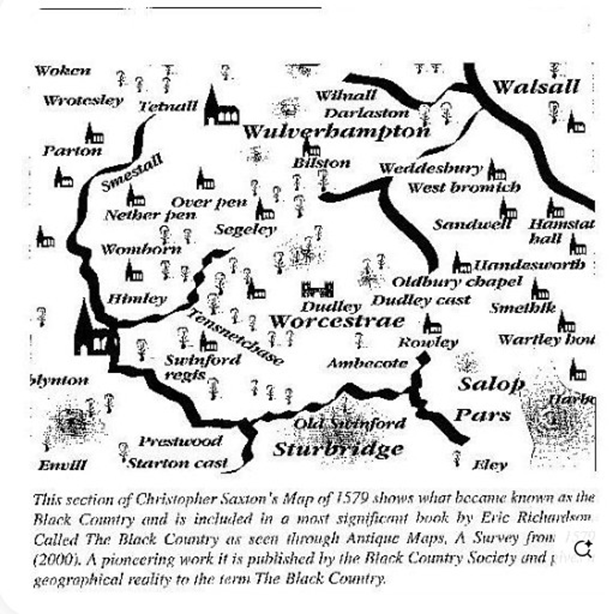
William Holden (1717-1806) had married Mary Rose, the daughter of John Rose (1688-1762) a prosperous Daventry saddler in September 1748 and although Mary died just four years later soon after giving birth, her maiden surname Rose lived on through successive generations of the Holden family. William was the grandson of another William Holden (1650-1699) and his wife Elizabeth Hyla, of Newport, Monmouthshire and the surname Hyla was also passed down through generations of the Holden family as a Christian name. The first Holden family member to bear this name was William’s younger brother Hyla Holden (1723-1766) who established a successful business in Wednesbury as a toy maker and enameller.
William Holden himself developed a flourishing saddler’s ironmonger business, possibly linked to his father-in-law’s saddler’s trade, branching out from Wednesbury to set up a business premises in Birmingham. Both of his two sons received a university education, his elder son John Rose Holden (b.1750) at Queen’s College, Oxford and his younger son William Lucas Holden (b.1752) at Clare College, Cambridge. Both were ordained as clergymen and John Rose Holden served as a curate in Edgbaston, Birmingham.
It is unclear whether William Holden had any connections with Upminster before he acquired the advowson of Upminster. In 1766 he acted as one of the executors to his brother Hyla’s will which mentions a mortgage and annuities held by James Esdaile of Bunhill Row, who was of course a major land owner in Upminster. A more tenuous connection was that Richard Molineux (d.1752), of the Wolverhampton family of ironmongers (after who the well-known football club ground is named), owned Harwoods in Upminster. Whatever the connection, having purchased the advowson of Upminster, when the Rectorship became vacant on the death of Rev John William Hopkins on 22 March 1780 William Holden presented his eldest son John Rose Holden as the new Rector. John Rose Holden had married Mary Tovey in 1771 while still a student and by the time of his appointment in 1780 the couple already had four children, and three others had died in infancy.
The new Rector spent much of his time in his London home and appointed a series of curates to minister to his parishioners’ needs, including from 1795 his son also named John Rose Holden. Throughout his Rectorship John Rose Holden the elder had a series of disputes with his parishioners but the most serious came in the late 1790s. The Rector’s income was mostly derived from the “tithes” – the right to collect a tenth of all the produce in the parish. By this time these had been collected as a fixed cash payment and in an era of inflation the Rector found the real value of his income was falling each year. On 30 May 1798 he gave notice to land owners and occupiers that from May 1799 he wished to collect his tithe “in kind” – actual produce or livestock. This caused much ill-feeling and on the day that this change was due to take place – 8 May 1799 – the Rector resigned, leaving his 26-year-old eldest son John Rose Holden the younger to pick up the pieces.

Born in Birmingham in 1772, and educated at Rugby School, John Rose Holden the younger attended Trinity College, Cambridge from 1790 and after obtaining his BA was ordained as a clergyman in September 1795, soon acting as his father’s curate at Upminster, and also serving as curate at Rainham from 1797. He was therefore familiar with the parish and local area when he was appointed as Rector in May 1799. If the parishioners thought that things might improve they were mistaken, for the incoming Rector pursued the cause with just as much diligence – and with as little success – as his father. His diary extracts (copied by Wilson) recorded how he tramped the length and breadth of the parish counting the head of cattle, sheep and lambs, estimating the amount of tithe each farmer had to give.
In fact things actually got worse as the Rector unwisely leased the collection of the tithes to a local farmer, Mr William Winton Edwards for £700 who was left to collect the tithes from the farmers as best as he could. Edwards’ collection methods caused even more antagonism with the locals and his lack of success in collecting tithe to the value of his lease led to him take the Rector to court and it was many years before the bad blood passed away. By this time this bitter tithe dispute had caused division between the farmers and the church and was one of the main factors which led a group of leading parishioners to set up their own Congregationalist meeting in 1800 and to build the Chapel on Upminster Hill which opened in 1801.

J R Holden the younger’s difficult relationships with his leading parishioners were again inflamed by the unpopular Rev James Bearblock, Holden’s curate at Upminster from 1817 onwards. Bearblock was strongly opinionated and in the late 1830s Champion Edward Branfill of Upminster Hall found remarks in one of Bearblock’s sermons so personally offensive that he took his family out of church, never to return again while Bearblock was a curate there.
It is not clear if relationships between John Rose Holden senior and junior had broken down but when the former rector, by then of Summer Hill, Birmingham, died in 1827 he left the advowson of Upminster and his lands and properties in the parish to his younger son Hyla, and nephew Henry Rose rather than to his older son, the current Rector.
The Rector’s relationships with his parishioners improved after the Rev Bearblock retired in 1839 and when the 1836 Tithe Commutation Act abolished tithes which were by law converted into rent charge payments. Tithe Commissioners were appointed, and they employed surveyors who produced a detailed map of land holdings in the parish and a schedule or agreement which apportioned charges for each parcel of land, identifying each owner and occupier. The resulting accurate large-scale map of the parish is considered to be the finest map of Upminster, and it is one of the biggest tithe maps in the Essex Record Office. Upminster’s tithe was assessed in 1842 to be a payment of £1,052 to the Rector.
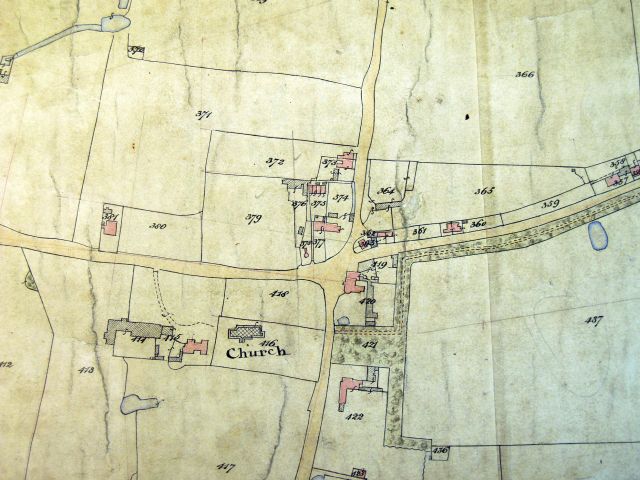
The Rector was afterwards fully involved in parish activities including as the setting up and management of the National School in 1851. His final and longest-lasting contribution to Upminster came at the end of his long incumbency of almost 63 years, when he contributed the sum of £1,000 towards the £1,278 cost of rebuilding St Laurence’s parish church. Sadly the Rector did not live to see the final results of his benevolence as he died on 28 January 1862, aged 89, a month before the newly rebuilt church was reopened.
With the Rector’s death there was the need to appoint his successor. His long incumbency had seen him outlive his younger brothers, the Rev William Rose Holden of Worcester (1775-1854) and Hyla Holden of Wasperton, Warwickshire (1776-1842). His younger brother Rev Henry Augustus Holden (1784-1870), his only surviving brother, had served as an ensign and lieutenant in the 17th Regiment of Foot during the Napoleonic wars before marrying his second cousin, Mary Willets Holden at Wednesbury in 1813. The couple had eight surviving children between 1814 and 1834 and he was a mature student of 32 years of age when he matriculated at Worcester College, Oxford in 1817. After obtaining his BA he was ordained in 1821, taking up a curacy in Wolstaston, Shropshire at a modest annual stipend of £80, and then in Warmington, Warwickshire in 1828.
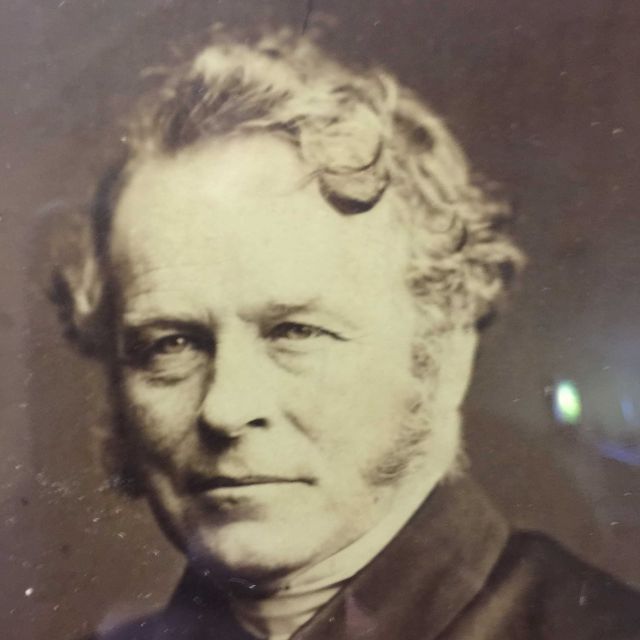
In a close-knit family such as the Holdens, Henry Augustus would undoubtedly have kept in touch with his older brother in Upminster. These contacts probably became more frequent after Henry Augustus moved to Bloomsbury in the 1830s and and his eldest son the Rev Henry Holden (1814-1909) succeeded the unpopular Rev Bearblock as John Rose Holden’s curate in 1839. Henry Holden was educated at Shrewsbury School and Balliol College, Oxford and after being ordained in 1839 he became a popular curate in Upminster for the next six years. He ran a small school in the parish and while he may well have been destined to succeed his uncle as Upminster’s Rector he instead became Headmaster of Uppingham Grammar School and then Head of Durham Cathedral School in 1853, until 1882, and he was appointed as an Honorary Canon of Durham Cathedral in 1867. He was a classical scholar, author and a keen photographer, and many of his pictures of school life at Durham survive. On retirement he became Rector of South Luffenham in Rutlandshire, retiring in 1888. After his death at Streatham in 1909 aged 94 he was buried in St Laurence Churchyard.
Another of Rev Henry Augustus Holden’s sons Luther Holden also had a brilliant career. Born in Birmingham on 19 December 1815 he was apprenticed aged 17 to Dr Stanley, Surgeon at St Barts Hospital London. In 1838 he became a member of the Royal College of Surgeons and gained a reputation as a teacher there, lecturing on anatomy and later becoming a full surgeon, writing several textbooks. In 1851 he married Frances Sterry, daughter of Benjamin Wasey Sterry of Hill House, Upminster, and after her death in 1863 he was said to have married her niece and ward, also named Frances (Fanny) Sterry 25 years Luther’s junior (there is some doubt about this marriage as on her death in 1920 her name was recorded as Frances Sterry, otherwise Holden). Luther Holden became President of the Royal College of Surgeons and when he died in 1905 he left £3,000 to St Barts to endow a “Luther Holden Scholarship in Surgery”. He was buried in Upminster churchyard and left a bequest to the Foundling Hospital where a portrait of him by Sir John Millais hangs.
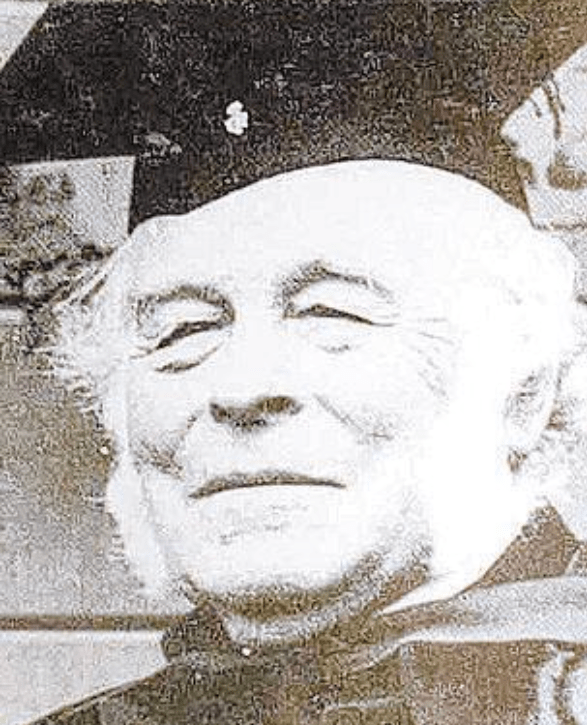
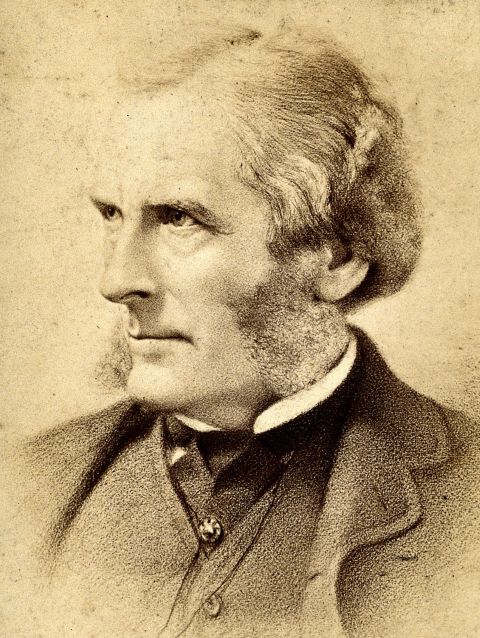
The choice of Rev John Rose Holden’s successor came to rest on his 39-year-old nephew Philip Melancthon Holden. Together with the name of his elder brother Luther this gives a clue to Henry Augustus Holden’s brand of Christianity. Luther was clearly named after Martin Luther (1483-1546), a central figure in the Protestant Reformation in the early sixteenth century whose theological beliefs form the basis of Lutheranism. Philip Melancthon (1497-1560) was counted among Martin Luther’s close friends and associates and it was his name that was was bestowed on Henry Augustus Holden’s son born in Daventry in 1823.
Like his father it does not seem that Philip Holden was originally destined for a career in the church. He entered King’s College, London aged 15 in 1838, obtaining a degree in the Faculty of Mining & Civil Engineering in 1840. He was appointed AKC – Associate of King’s College the next year – attending courses in divinity as part of his degree. Henry Augustus Holden and family moved to 46 Addison Road, Kensington in around 1850 and Philip is shown there as a Civil Engineer in the 1851 census. The Kensington house was later said to have been “the resort of many persons well known” and that the Holden children were “brought up amidst divines and wits”. Soon afterwards Philip Holden must have decided on a career change as in March 1854 he was ordained deacon at Worcester and appointed as curate at St Helen’s in that town, where his uncle William Rose Holden (1775-1854) was curate at All Saints. Philip Holden was later curate at Hammersmith and Minister at St Paul, Great Portland Street, London.
Philip Holden made an instant impression in Upminster. Over six feet tall he had a striking presence and flamboyant style of dress and “his hirsute appendages were such as no one else in the neighbourhood possessed”. He was a flamboyant character who in his early years drove a white pony in a white carriage, with a white harness and whip and attired in a white dress and hat. On one occasion he was mistaken for the forerunner of a circus pageant that was due in a few hours! He possessed “a powerful and resonant voice” and his “fire and brimstone” orations were rarely dull, as his sonorous voice and eloquent speech were a marked contrast to his predecessor. He soon became renowned throughout the neighbourhood for his brilliant oratory and Sunday services at St Laurence’s Church were soon crowded with local parishioners and visitors from miles around. He also gave public recitations, including readings from Shakespeare, which attracted large and appreciative audiences.


However, Philip Holden’s popularity was short-lived and “complaint, dissension and disputes arose in the parish”. For much more colourful information about this remarkable character – read his story here!
P M Holden died in June 1904 aged 81 and as he had no male heir it was necessary to again cast the net among the wider family. The Rectorship was first offered to the Rev Oswald Mangin Holden (1843-1938), Rector of Steeple Langford, Wiltshire but already aged 60 he decided to stay at Steeple Langford, although the living there was less valuable than that at Upminster. The Rectory was instead offered to Rev Hyla Henry Holden, nephew of the late minister, who was then Curate of St Alban, Leyton. Born in Weymouth in 1873, the son of William Rose Holden, Barrister (1839-1897) and Henrietta Pidcock he had grown up in Dover, and attended Worcester College, Oxford, graduating in 1896. He then went on to study at Cuddesdon College, Oxford, one of the leading Church of England Theological Colleges which produced many high-ranking Anglican clergy.
Ordained as a deacon in 1898 and priest the following year Rev Hyla Henry Holden served as curate at St John, Walham Green, Fulham from 1898 to 1901, and then at St Andrew Croydon. He went on to serve as a lay assistant to the Bishop of London as head of Oxford House, Bethnal Green which had been founded in 1884 as a “settlement” house for Oxford university graduates volunteering among the poor communities of east London communities.
Rev Holden was a member of the Oxford Movement which revived Anglo Catholicism in the Church of England. He introduced vestments to the worship at St Laurence and the use of the term Mass for Holy Communion which changed the style of worship, restoring what was later described as the “Faith of our Fathers”. He went on to modernise parochial life at St Laurence Church and to make the church a more welcoming place for Upminster’s growing population, soon doubling the number of Sunday services from two to four and celebrating communion at least weekly instead of monthly. For the first time, the local community was encouraged to be involved in the life of the church, a parish magazine was introduced, and a scheme for warming the church was successfully carried out, making the church warm and dry. A new choir was kitted out with new cassocks and surplices, made by ladies of the congregation, and by March 1905 extra services were added on Friday and Saturday evenings.
The Rev Hyla Holden was thoroughly involved in community service, not only as a member of the Upminster Parish Council, a sergeant of the Special Constables and Captain of the Upminster Fire Brigade but also serving on the Romford Rural District Council and as a Member of the Romford Board of Guardians. He served as a temporary Chaplain to the British forces in 1918 and 1919.
At Oxford he was a good all-round athlete competing at running, hockey, cricket, rugby, football and he had a half blue for hockey. He continued as a keen sportsman and an active member of Upminster Cricket Club and he also played tennis and hockey. He also re-established the popular May Festival with the May Queen Celebration, with his daughter Kathleen as the first May Queen in 1913.

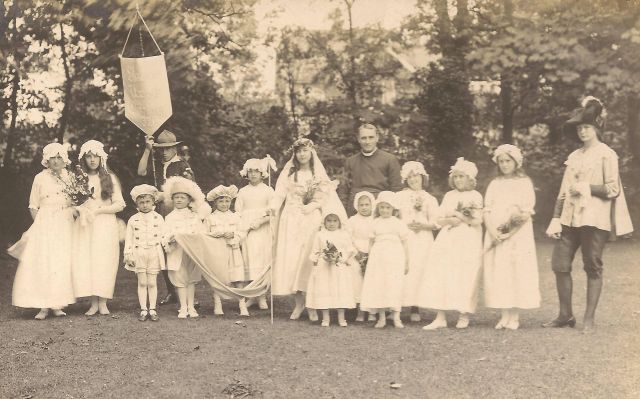
After a series of repairs and improvements to the church, including gas lighting in 1912, St Laurence’s was significantly enlarged in 1928–9. When St Laurence Church expansion was started in July 1928 the foundation stone was laid with full masonic ceremony attended by prominent “Brethren of the Craft” wearing their full regalia. Rev Holden had became a mason in 1895 while still a student at Oxford, becoming a member of the Apollo University Lodge (357), and later became a founder member of the Upminster Ingrebourne Lodge (3345) when it was formed in December 1908.
The Rev Holden had married Harriet Donovan in 1900 when he was a curate at Walham Green and by the time that he came to Upminster the couple had three children: Kathleen (b.1900), Hyla Rose (b. 1902) and William Edward Paul (known as Paul b. 1903); a fourth child Betty followed in 1907. After the death of his wife Harriet in 1938 the Rector married Miss Alice Edwards, a member of his choir and headmistress of Parsloes Infant School Dagenham who had helped nurse him back to health after a recent illness. The Rev Holden retired owing to ill health on his 70th birthday in September 1943, after almost 40 years of service to Upminster and the Diocese where he served as Rural Dean, moving to Cornwall where he sadly died the following year.
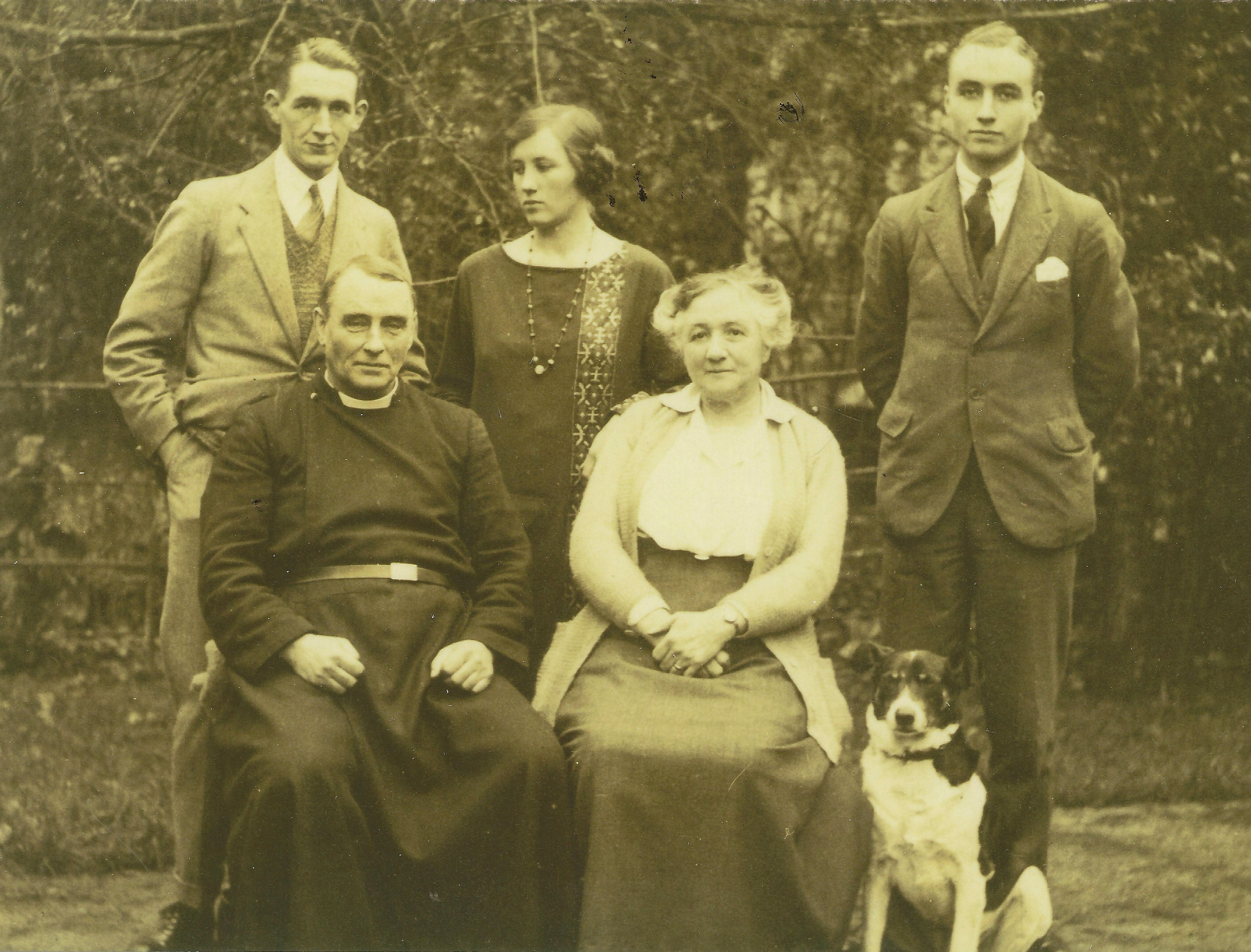
Seated: Rev Hyla Henry Holden and his wife Harriet
The Rev Holden’s long incumbency covered Upminster’s rapid growth with the Garden Suburb and later developments of the New Place and Gaynes Park estates – a crucial era for the town’s development from an Essex village to a London suburb. He made a significant contribution to Upminster and St Laurence Church during his incumbency.
His son Rev Hyla Rose Holden – appropriately bearing both the traditional family names – succeeded him, the fifth successive member of the Holden family to serve Upminster. Unlike his father and many other members of the Holden family, it did not seem that he was destined for the cloth. After leaving the distinguished Sherborne School, instead of following the traditional family route of enrolling at Oxford or Cambridge university Hyla Rose Holden chose a life at sea, joining the Royal Naval Reserve in the Merchant Service as an apprentice in 1921 aged 18.
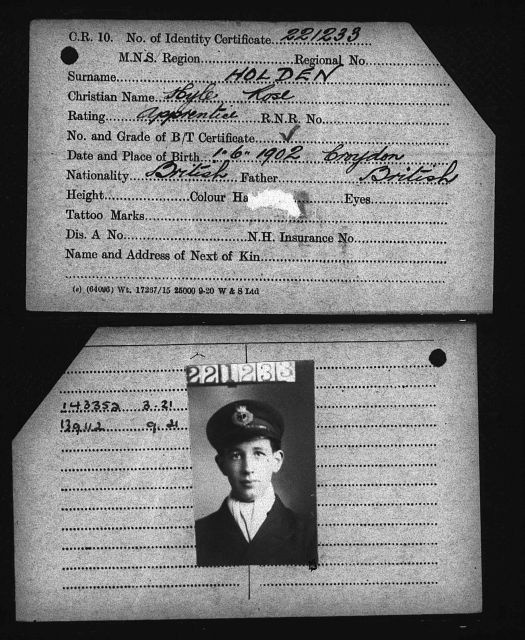
The story goes that when he was home on leave in 1926 he made a life changing decision. His father was driving him back to Tilbury and on the way asked him if he would like to prepare for ordination, which he said he would and they promptly turned back, ending his merchant navy career. He enrolled at Sarum Theological College, Salisbury and successfully completed his studies and was ordained as a deacon in 1930 aged 28 and as priest the following year. He was appointed curate at the parish of St John the Baptist, Atherton, Manchester in 1930, remaining there for five years, spending two years there in charge of a district. He was then appointed to St James’ Church, Cowley (Oxford) before moving to St Andrew’s Caversham Heights, Reading as priest-in-charge in October 1937. He was called up for war service two years later in the Army Chaplains’ Department at the rank of Captain before he succeeded his father at Upminster.
His time as Rector saw further changes to Upminster, as landmarks like The Cosy Corner and The Bell Inn were demolished in the name of improvement, Upminster’s Capitol Cinema, renamed the Odeon in 1946 and the Gaumont from August 1949, closed in July 1961 and was redeveloped as a Top Rank bingo club and Upminster’s once quiet roads gave way to motor cars.
Rev Hyla Rose Holden continued in the steps of his father, remaining as Rector for 27 years until his retirement in 1971, ending an unbroken era of 191 years where Upminster was served by a Rector who was a member of the Holden family. He lived quietly in Hadleigh until his death aged 93 in 1995, three years after his wife died.
The Holden family continue to hold the advowson of Upminster Rectory. The last Holden patron William Rose Holden, continued to maintain regular links with St Laurence Church and with his passing after the formalities are complete this honour will pass to his son Simon.
Further Reading
The Upminster History Group: The Story of Upminster: Book 8 Church and Rectors (June 1859)
Religious History of Upminster – handwritten notes T L Wilson (1907) – photocopy LB Havering Local Studies Library
 Old Upminster
Pingback: Historic Upminster Hill | Old Upminster
Pingback: Upminster: St Laurence, Parish Church | Old Upminster
Pingback: Upminster Rectory and the Parish Glebe | Old Upminster
Pingback: Lily’s World | Old Upminster
I felt sure there was going to be a mention of Holden Way – one of the most desirable addresses in Upminster. (At least it used to be, things may have changed since I left in 1975….)
Good point. Thanks. Yep still desirable.
I have only just stumbled across your prolific work on Upminster’s history. Perhaps it’s when you reach 70 you start to get a bit more nostalgic!? I was born in Courtenay Gardens in 1954 and left in 1976 – married at the Baptist Church in Springfield Gardens.
You’re to be congratulated on your work – and I have just ordered your book!
Regards
Adrian
Thanks for your comments. Still aiming to edit these web articles into another book.